2027 Hiring Signals: Why Employers Are Trusting Verified Skill Certifications Over Degrees
 General
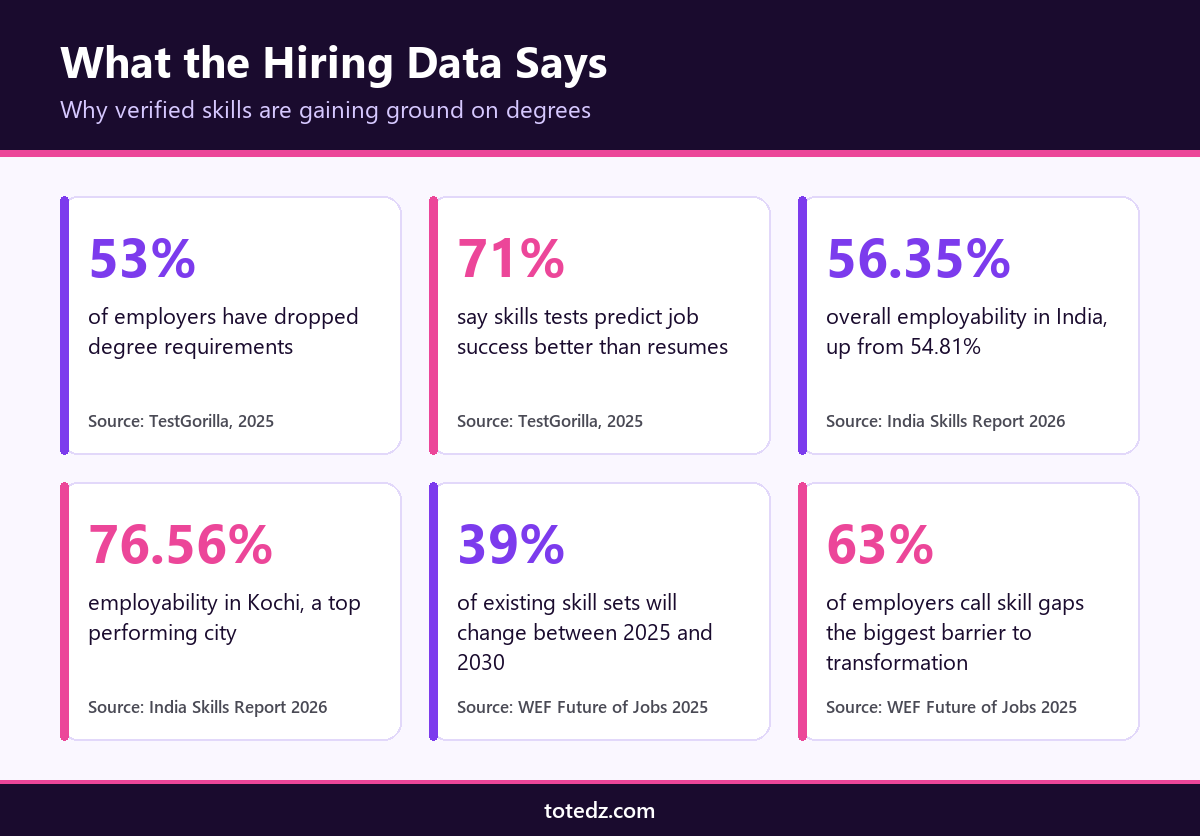
The resume is losing its grip on hiring decisions. TestGorilla's State of Skills-Based Hiring 2025 report found that 53% of employers have dropped degree requirements, up from 30% a year earlier. For learners weighing the online career courses India now offers, that shift changes what a strong application looks like. If you want help mapping your own path, you can talk to the Totedz team before you choose a course. This guide explains which hiring signals are rising, why verified certifications now carry weight, and how to pick learning that employers can actually check.
Key Takeaways
- Employers increasingly screen for proven skills, so the online career courses India learners pick should end in assessed, verifiable work rather than an attendance certificate.
- The most useful career mentorship program for freshers India 2027 job seekers can join will pair structured learning with feedback on projects, portfolios and interviews.
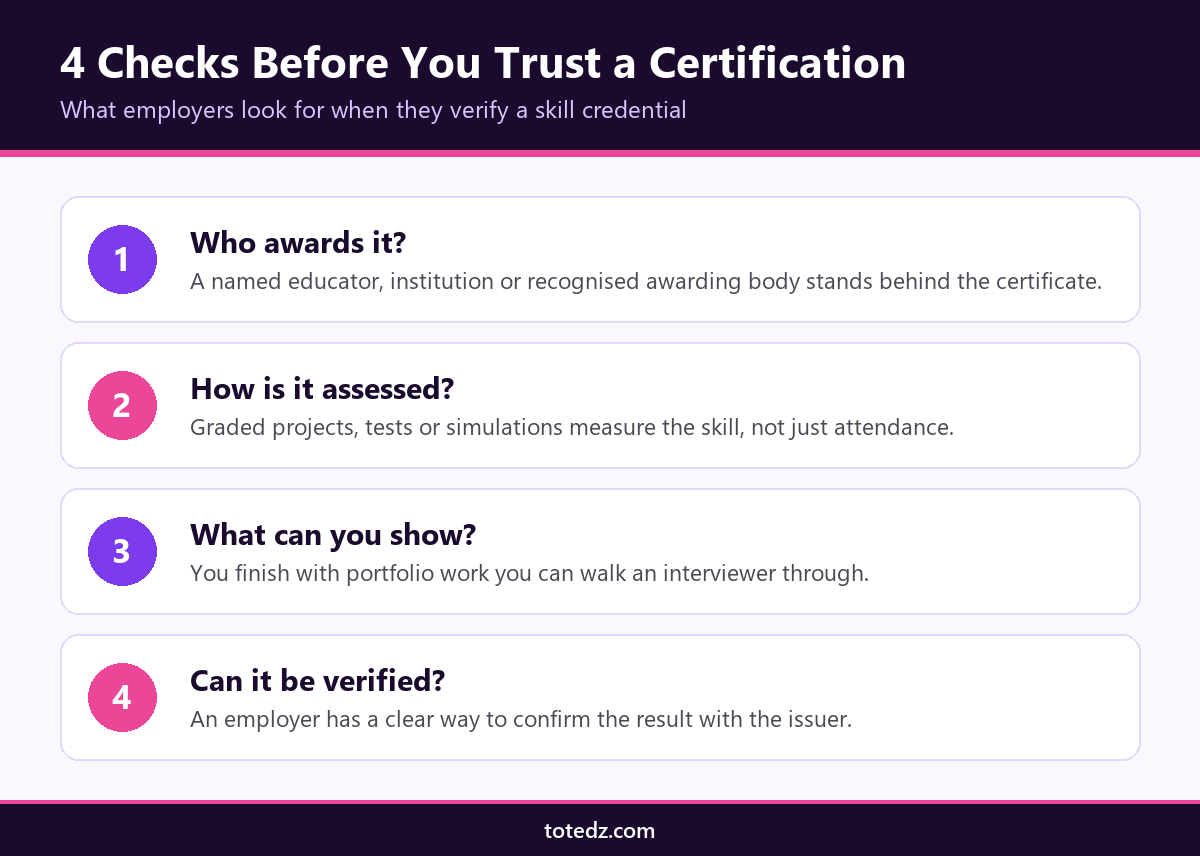
- When comparing skill based online certification courses near me, check who awards the credential, how it is assessed and whether an employer can verify it.
Signal One: Skills Proof Is Replacing the Degree Filter
Hiring teams are not abandoning education. They are changing how they measure it, and the survey data shows how fast that change is moving.
In the TestGorilla survey of 1,084 hiring decision makers in the US and UK, 85% said they use skills-based hiring in 2025, up from 81% the previous year. Three in four (76%) now use skills tests to validate candidates. And 71% agree those tests predict success on the job better than resumes do.
The reason is practical. Two in three employers said skills testing reduced mis-hires, and 65% said it shortened their time to hire. A degree tells a recruiter that you completed a programme. A verified skill certification, backed by an assessment or a project, tells them what you can do on your first working day.
The same study found that 84% of employers were satisfied with the hires they made using skills tests. For job seekers, the message is clear. A credential that proves a skill through assessment is easier for a recruiter to trust than a resume line that simply names the skill.
India is moving in the same direction. The India Skills Report 2026 notes that employers increasingly value proof of ability, digital portfolios, project outcomes and peer reviews over academic transcripts. For graduates, the degree still opens doors. The evidence attached to it decides who walks through them.
Signal Two: India's Employability Gap Is Closing, but Not for Everyone
Official figures show steady progress in job readiness. They also show how many candidates still fall short of what employers expect.
A Ministry of Skill Development and Entrepreneurship statement from July 2025 cites youth employability of 51.25% in 2024, compared with 40.44% in 2017. The latest India Skills Report puts overall employability at 56.35% for 2026, up from 54.81% a year earlier.
That still leaves a large share of candidates who test below job ready levels. The same report found that 92.8% of candidates want internships, which shows how hungry learners are for practical exposure. Kerala readers have reason for optimism too. Kochi recorded 76.56% employability, placing it among the top performing cities alongside Lucknow, Pune and Bengaluru.
Age matters as well. Candidates aged 22 to 25 were the most employable group at 75.7%, which suggests the first few years after graduation are when focused upskilling pays off most. That is exactly the window in which many freshers decide between another degree and a targeted certification.
The lesson for anyone comparing online career courses India platforms list is simple. Employability rises when learning includes applied practice and honest assessment. Courses that end with a quiz and a PDF do little to move that number. Courses that demand real output, reviewed by someone qualified, do.
Signal Three: Verified Now Means Something Specific
Not every certificate is a credential. Employers trust a certification when three questions have clear answers: who set the standard, who assessed the learner, and can the result be checked?
India has built public infrastructure around those questions. The National Council for Vocational Education and Training, set up in December 2018, regulates awarding bodies and assessment agencies. Its National Skills Qualification Framework sets national principles for recognising skill proficiency at different levels. The ministry also reports that 36 industry led Sector Skill Councils help define competency standards for their sectors.
Private learning platforms sit alongside this system rather than replacing it. Whether you search for skill based online certification courses near me or study fully online, look for these markers:
- A named educator or institution behind the course
- Graded assignments, projects or simulations, not only video lessons
- A portfolio piece you can walk through in an interview
- Clear information on how the certificate is issued and verified
If you are exploring a technical field, our guide on how a machine learning certificate is structured shows how these markers apply in practice.
It also helps to ask a provider a few direct questions before you pay. Who reviews my project work? What does the assessment involve? Can an employer confirm my result? A credible provider will answer these clearly. Vague answers are a signal in their own right.
Signal Four: Skills Are Changing Faster Than Degrees Can Update
Employers are not only testing skills. They are also planning for skills that many syllabi do not cover yet.
The World Economic Forum's Future of Jobs Report 2025 estimates that 39% of workers' existing skill sets will be transformed or become outdated between 2025 and 2030. It also found that 63% of employers see skill gaps as the biggest barrier to business transformation, and 85% plan to prioritise upskilling their workforce.
The report frames the scale neatly. If the world's workforce were 100 people, 59 would need training by 2030. A three or four year degree cannot refresh itself at that pace. Short, focused certifications can, which is why employers read them as a sign that a candidate keeps learning.
For learners, that means the certificate is only the start. Interviewers will also ask what you learned recently and how you applied it. Keeping a simple learning log, updated after each course or project, gives you a ready answer and shows the habit of continuous learning employers now reward.
This is where guidance matters, because choosing the wrong course wastes months. At Totedz, every learner is paired with a mentor who helps set goals, stay accountable and adjust the plan as priorities change. You can see how that works on our mentor led learning page, then browse courses across technology, data, marketing and finance to find a starting point.
How Freshers Can Prepare for the 2027 Hiring Season
Looking ahead, the safest bet is to treat the next twelve months as one long portfolio project.
Pick one target role and study live job descriptions for it. List the skills that repeat, then choose one course that teaches them through practical work. Finish it fully before starting another. Among online career courses India learners can access, the ones worth your time will show you exactly what you will build.
Any course works best when it fits a plan, not an impulse. Set a realistic weekly study schedule, share it with your mentor and review progress every month. Small, consistent steps build a stronger portfolio than a burst of enrolments that never finish.
Next, find someone who can review your progress. A good career mentorship program for freshers India 2027 candidates can rely on should offer feedback on projects, mock interviews and a clear plan for what to learn next. Finally, collect evidence as you go: project links, assessment results and short notes on problems you solved. Those are the signals hiring teams now look for.
Conclusion
Degrees still matter, but they are no longer the only signal employers trust. The data points one way: skills tests, verified credentials and visible project work are shaping who gets hired. Choosing online career courses India employers respect means checking who awards the certificate, how it is assessed and what you will build along the way. Pair that with a mentor who keeps you on track, and your application tells a clearer story. Learn more about the people behind Totedz, or reach out to our team to plan your next step today.
Frequently Asked Questions
Are employers really hiring without degrees now?

What makes a skill certification verified?
Do employers recognise online career courses India learners complete?
How does a career mentorship program for freshers India 2027 hiring needs help?
How do I choose skill based online certification courses near me?
Is a degree still worth it if employers prefer skills?
Why are employers using skills tests instead of resumes?
How fast are job skills changing?
How does Totedz support learners choosing a course?