How to Choose the Right Career Mentorship Program
 General
Not every career mentorship program delivers the same thing, even when the marketing sounds nearly identical. Some are a single generic call dressed up as mentorship, others are structured, multi week relationships with someone who has real experience in your target field. This guide covers exactly what to check before you commit money and time, so you can tell a genuine program apart from a repackaged advice session.
Key Takeaways
A real career mentorship program has structure: a set number of sessions, defined milestones, and a mentor with relevant, verifiable experience.
Mentor background matters more than credentials alone; ask what field they actually worked in and for how long, not just their title.
The best programs end with a written plan, not just a conversation you are left to remember and interpret on your own.
Check the Mentor's Real World Background First
Before anything else, find out what the mentor actually did before they started mentoring, rather than accepting a polished profile at face value. A career mentorship program is only as good as the person running it, and a mentor who spent years hiring or working directly in your target field will catch things a generalist coach simply cannot see. Ask directly for their work history, including specific companies or roles, rather than accepting a vague "industry expert" label on a website.
It also helps to ask how recently that experience was gained. A mentor whose direct field experience is a decade old may still offer valuable general guidance, but industries such as technology and digital marketing change quickly enough that recent, hands on exposure often matters more than years of total experience alone.
Do not be shy about asking for specifics during an introductory call, such as the names of companies they worked at or the kind of roles they held. Mentors confident in their background answer these questions directly and briefly, while vague or deflecting answers are usually a sign the experience being marketed is thinner than it sounds.
Look for Defined Structure, Not Just Conversations
A program built around genuine career mentorship should have a clear number of sessions, a stated total duration, and specific milestones you are expected to work toward between calls. If a provider cannot describe what session three or four will actually cover before you sign up and pay, the program is very likely improvised on the spot rather than designed around measurable outcomes.
Ask specifically what happens between sessions as well. Strong programs assign a small piece of work, such as researching a specific option or drafting part of a plan, so that each session builds on the last rather than starting over from the same open ended question every time.
A useful way to test this before enrolling is to ask for a sample session outline or agenda. Providers who run a genuinely structured program can usually produce one immediately, since it already exists as part of how they deliver the course.
Compare Group Programs Against One to One Mentorship
Group formats generally cost less and expose you to a range of peer perspectives you would not get in a private session, which has real value for common, well understood situations. One to one mentorship, on the other hand, allows the mentor to tailor advice specifically to your background rather than addressing the average participant in the room.
If your situation is unusual, such as a career switch into a completely unrelated field or an atypical academic background, one to one guidance is usually worth the extra cost over a generic group cohort, since a shared curriculum cannot easily account for an outlier case like yours.
Some programs offer a hybrid format, combining group sessions for shared content with occasional one to one check ins for individual questions. This can be a reasonable middle ground if budget is a constraint but your situation still needs some tailored attention.
Ask What Happens After the Program Ends
A strong career mentorship program leaves you with a written roadmap and, ideally, some form of follow up check in scheduled after the formal paid sessions officially end. Online courses with a mentor component built into the same platform can also extend the relationship naturally, since the mentor already understands your goals in detail once you move on to structured skill building afterward.
Before enrolling, ask what the provider considers a completed engagement. A program that simply stops contacting you once the final invoice is paid is a weaker signal than one that builds in even a single follow up call a month or two later to check on real progress.
This matters more than it might seem, since most of the value from mentorship shows up in how you apply the advice weeks later, not in the sessions themselves. A program with no follow up leaves that final, important step entirely up to you.
Verify Reviews From Someone in a Similar Situation
Generic testimonials are easy to write and difficult to verify independently. Where possible, ask the provider to connect you with a past participant who had a similar starting point to yours, whether that is a recent graduate, a career switcher, or a working professional balancing a full time job alongside the program.
A career counsellor's education and professional background are also worth confirming directly during an introductory call rather than trusting a short website bio alone, since bios are marketing copy first and an accurate professional history second.
If a provider is reluctant to connect you with even one past participant, treat that as a meaningful signal. Programs confident in their outcomes are generally happy to let a prospective participant hear directly from someone who has already been through it.
Conclusion
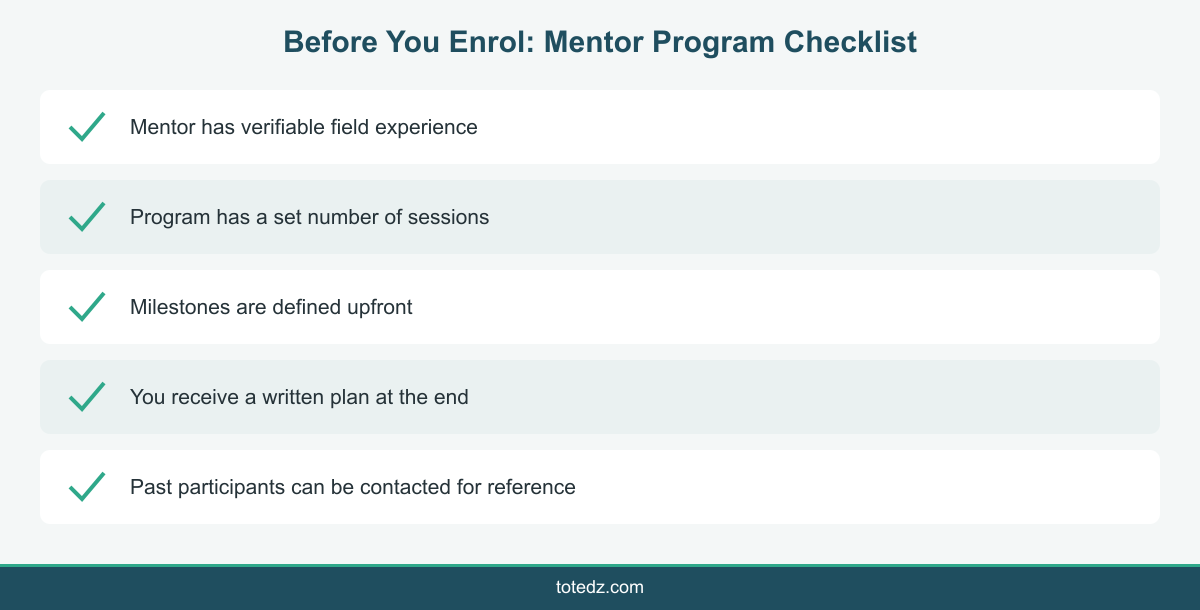
Choosing a career mentorship program comes down to three checks: a mentor with real, verifiable experience in your target field, a structured plan rather than open ended conversation with no clear shape, and a written output you can act on well after the program officially ends. Skip any program that cannot describe its own structure clearly before you pay for it. Talk to a Totedz counsellor to find a mentor matched to your specific background and goals.
Frequently Asked Questions
How long should a career mentorship program run?

Is a one time consultation the same as a mentorship program?
What questions should I ask a mentor before starting?
Do career mentorship programs guarantee a job?
Can a mentorship program work alongside a full time job?
What is the difference between a coach and a mentor?
How much should I expect to pay for a quality mentorship program?
Should I choose a mentor from my exact target company?
How does Totedz select mentors for its programs?
Can academies offer mentorship programs through Totedz?