Career Counselling Online: What to Expect and How It Works
 General
Career counselling online can feel like a black box before your first session: what actually happens on the call, how long it takes, and whether you will walk away with anything more concrete than general encouragement. This guide walks through a typical session structure so you know exactly what to expect and how to prepare before you book.
Key Takeaways
A structured online counselling session moves through assessment, options, and a concrete next step, not just open ended conversation.
Preparation matters: bringing specific constraints gets you sharper advice than starting from a vague opening question.
The best sessions end with something written down, whether a summary email or a short roadmap you can revisit.
What a Typical Session Actually Covers
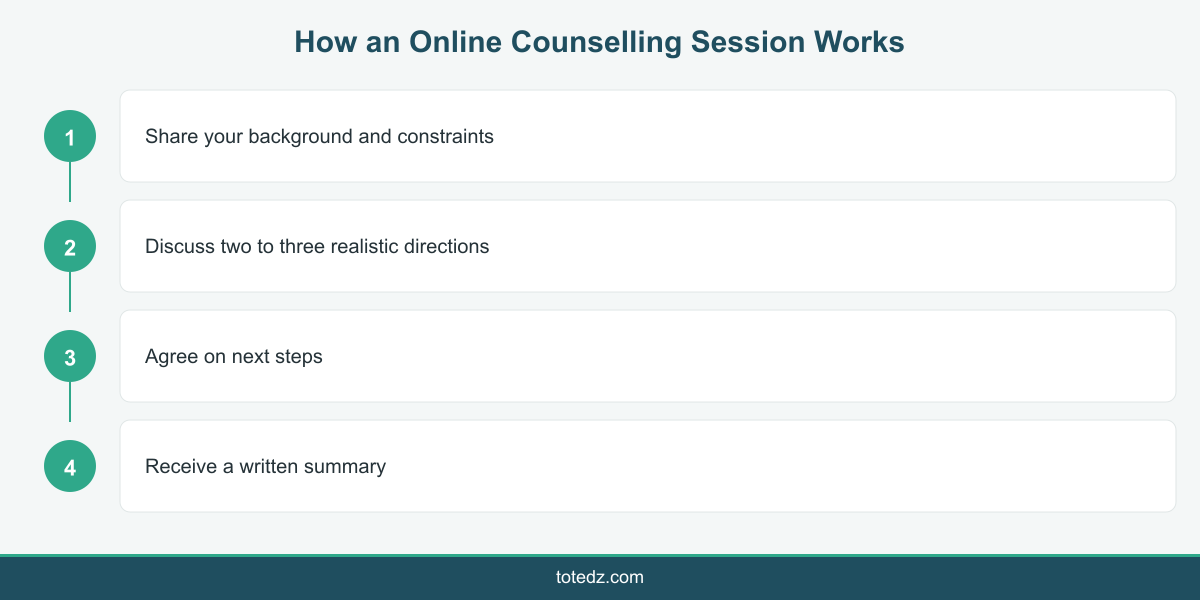
Most career counselling online sessions start with a short assessment of your background, interests, and constraints, followed by a focused discussion of two or three realistic directions, and end with agreed next steps you both write down before the call ends. A full first session usually runs thirty to sixty minutes, though a detailed initial assessment can run longer if your situation involves several competing options.
Later sessions tend to be shorter and more focused, since the groundwork from the first call carries forward. Expect these to concentrate on reviewing what you have done since the last session and adjusting the plan based on what you actually learned, rather than repeating the same broad assessment each time.
Some providers also send a short pre call form to fill out before the session, covering your background and current questions. Completing this properly, rather than leaving it blank and relying on the live conversation to cover everything, tends to make the session itself considerably more productive.
How to Prepare Before Your Session
Arrive with specific information ready: your current stage of study or work, a rough budget for further courses, and any fields you are already leaning toward even if you are not fully committed. Counsellors trained in career counseling methods can work with vague starting points, but sessions move faster and go noticeably deeper when you bring concrete constraints instead of a blank slate.
It also helps to write down two or three specific questions before the call, rather than relying on memory once the conversation starts moving. Sessions are often the most useful when they answer a question you arrived with, rather than only covering whatever the counsellor happens to raise first.
If you have already done some research on your own, bring it along rather than starting from scratch in the session. A counsellor can react to and refine existing thinking far more efficiently than building a view from nothing in a single call.
What Qualifications a Counsellor Should Have
A counsellor's background matters just as much as their manner on the call. Ask about their training and, just as importantly, whether they have direct exposure to the fields they advise students on regularly. A counsellor whose own experience matches your target industry will typically give more specific, actionable guidance than a generalist covering every field equally.
Do not hesitate to ask directly about a counsellor's education and prior roles before booking, particularly if your situation is specialised. A counsellor with a strong general background but no direct exposure to, say, a niche technical field may still be useful for structure and process, but less useful for field specific detail.
Platforms that let you review a counsellor's profile before booking make this easier, since you can compare backgrounds across a few options rather than committing to the first name suggested to you.
How Online Sessions Compare to In Person Counselling
Online counselling removes travel time entirely and widens your choice of counsellor well beyond your own city, which matters considerably if your target field has few local specialists. It works just as well as in person sessions for most students, provided the connection is stable and you have a quiet, private space to focus during the actual call.
The main trade off is the loss of some informal, in person rapport building that a physical meeting allows. For most goal focused sessions this makes little practical difference, though some students genuinely do prefer the in person format for a first meeting before moving to online follow ups.
For students in smaller towns, the online format is often not just a convenience but the only realistic way to access a counsellor with specific field experience, since equally qualified local options are frequently unavailable.
Turning the Session Into a Plan You Can Act On
A session is only as useful as what you actually do with it afterward. Ask for a written summary or a short list of next steps before the call ends, and use it to shortlist relevant courses in the days that follow while the conversation is still fresh in your mind.
Reviewing career guidance resources between sessions also helps you arrive at your next call with sharper, more specific questions rather than starting from the same general uncertainty each time. Treat each session as one step in an ongoing process rather than a single event that should resolve everything at once.
Set a specific date to act on at least one recommendation from the session within the following week. Advice that sits unused for a month tends to lose urgency, while acting quickly keeps the momentum from the conversation alive.
Conclusion
Career counselling online works best when you treat it as a structured, ongoing process rather than a single conversation you hope will resolve everything. Prepare specific questions, ask about the counsellor's real background and training, and insist on a written next step before the session ends. Book a session with a Totedz counsellor to get started with a plan you can actually act on.
Frequently Asked Questions
How long does an online career counselling session usually take?

Do I need to prepare anything before my first session?
Is online counselling suitable for school students as well as graduates?
What happens if I disagree with the counsellor's recommendation?
How many sessions does it usually take to get clarity?
Can online counselling help with a mid career switch, not just students?
Are online counselling sessions confidential?
What if I only have one specific question, not a full career review?
How does Totedz match students with the right counsellor?
Can institutes offer counselling services through Totedz?