Career Guidance and Mentorship for Students: Complete Guide
 General
Choosing a career used to mean picking one of a handful of well worn paths. Today a student researching career guidance and mentorship has to weigh hundreds of course formats, certifications, and platforms before even picking a direction. This guide breaks down what real career guidance and mentorship looks like in practice, how mentorship programs and online counselling actually work session by session, and how to turn that guidance into a course plan that fits your goals rather than someone else's.
Key Takeaways
Career guidance and mentorship works best as an ongoing relationship, not a single session, and it should combine self assessment, market information, and course selection.
A career mentorship program pairs you with someone who has already done the work of separating useful skills from noise, which shortens your own trial and error.
The right career roadmap connects guidance to action: specific courses, certifications, and milestones with dates attached, not just a list of options.
What Career Guidance and Mentorship Actually Mean
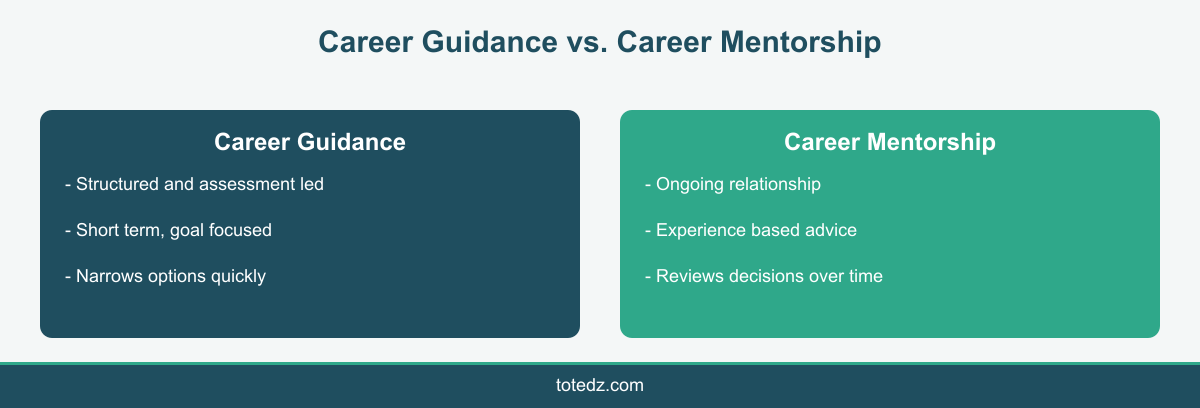
Career guidance and mentorship are related but not identical, and the difference matters once you start looking for support. Career counseling is typically structured and goal driven: an advisor helps you assess strengths, interests, and options against real labour market information, then narrows a wide field down to a short list you can actually research in depth. Mentorship is more relational and less bounded by a single session. A mentor, usually someone further along in a field you are interested in, shares first hand experience, reviews your decisions as you make them, and helps you avoid mistakes they already made themselves earlier in their own career.
In practice, the two overlap constantly rather than staying in separate lanes. A good counsellor often behaves like a mentor once the relationship continues past the first session, checking in on how a recommendation actually played out. A good mentor, in turn, will use counselling style tools, such as structured skills assessments or goal setting frameworks, when a mentee is stuck and needs more than encouragement. What matters for a student is not the label attached to the relationship but the outcome it produces: clearer options, a shorter list of realistic paths, and someone to check your reasoning against before you commit real time and money to a course or a career direction.
It also helps to know which one you need at a given moment, since asking for the wrong kind of support can leave you frustrated with a service that was never designed to solve your actual problem. If you are choosing between three specific options this month, structured counselling will likely resolve it faster. If you are two years into a field and want an honest read on whether you are on the right track, a mentor who has already walked that path will usually give you a more useful answer than a fresh assessment would.
Why Students in India Need Structured Career Guidance Today
The number of course options available to an Indian student has grown far faster than the support available to choose between them. A decade ago the choice was largely between a handful of established degree tracks. Today the same student is choosing between formal degrees, short certifications, bootcamps, and hybrid programs, often in fields that barely existed when their parents were making similar decisions. Government platforms such as the National Career Service and skilling bodies under the Ministry of Skill Development and Entrepreneurship exist precisely because informal advice from family and friends no longer covers the range of careers now open to graduates, especially in technology, digital, and services roles.
This growth in choice is generally a good thing, but it shifts the real bottleneck from access to information toward the ability to filter it. A student today can find a course for almost any skill within minutes, yet still struggle to know which of ten similar sounding options is actually worth their time. Structured guidance exists to solve that specific filtering problem, not to hand over information that is already freely available everywhere online.
The Cost of Getting It Wrong
Choosing a course or specialisation without guidance is rarely fatal, but it is expensive in time, which is the resource students can least afford to waste. A student who picks a certification based on a friend's recommendation, discovers a year later that it does not match their actual strengths, and has to switch direction has lost time that structured guidance could have saved at the very start. Graduate unemployment data consistently shows mismatch between what graduates study and what employers actually need as a recurring driver of underemployment, not simply a shortage of jobs in the economy overall.
How Access to Guidance Has Changed
A decade ago, structured career guidance was mostly available through overworked school counsellors or expensive private consultants concentrated in a handful of large cities. Online counselling and mentorship platforms have brought the cost down considerably and made it possible to speak with someone who actually works in your field of interest, rather than a generalist covering every field at once. That shift is also what makes a marketplace model, where multiple academies and mentors are reachable from a single platform, genuinely useful rather than just convenient.
Career Mentorship Programs: What They Look Like in Practice
A structured career mentorship program typically runs for a fixed period, often eight to twelve weeks, built around regular one to one sessions rather than a single consultation you have to remember unaided. Sessions usually start with an honest assessment of where you currently stand, move into goal setting around a specific target, and then track progress against milestones such as completing a certification, finishing a portfolio project, or applying to a set number of relevant roles within an agreed window.
The value of a good program is less about information, which is freely available online to anyone willing to search for it, and more about accountability and pattern recognition that only comes from experience. A mentor who has actually hired people, or worked closely alongside them, in your target field can tell you quickly whether a plan is realistic given your starting point, and can flag gaps you would not notice on your own, such as a portfolio that looks technically strong on paper but does not demonstrate the collaboration skills employers screen for in interviews.
Most programs also build in a review of your existing work, whether that is academic projects, a portfolio, or prior work experience, during the first one or two sessions. This early review matters because it grounds the rest of the mentorship in your actual starting point rather than a generic template that assumes everyone begins from the same place.
Career Counselling Online: How It Works Today
Online career counselling has moved well beyond a single video call booked in a hurry before an application deadline. Most structured programs now combine an initial assessment, either a detailed questionnaire or a live discussion, with a written summary of recommended directions, followed by scheduled check ins as you act on the plan over the following weeks. This format works particularly well for working professionals and students in smaller towns who would otherwise need to travel to a major city for a single in person session with a specialist counsellor.
If you are booking an online counselling session for the first time, come prepared with specific questions rather than a general "what should I do with my life" opening. Counsellors can give much sharper, more useful guidance when you bring concrete constraints to the table, such as your budget, your available timeline, or a shortlist of two or three fields you are already leaning toward, than when the entire conversation has to start from a completely blank page.
Expect the counsellor to ask about your constraints in return, not just your ambitions. A realistic recommendation depends on knowing what you can actually commit to in terms of time and cost, and a counsellor who skips this step is more likely to hand you an idealised plan that does not survive contact with your real circumstances.
Building a Career Roadmap: From Confusion to a Plan
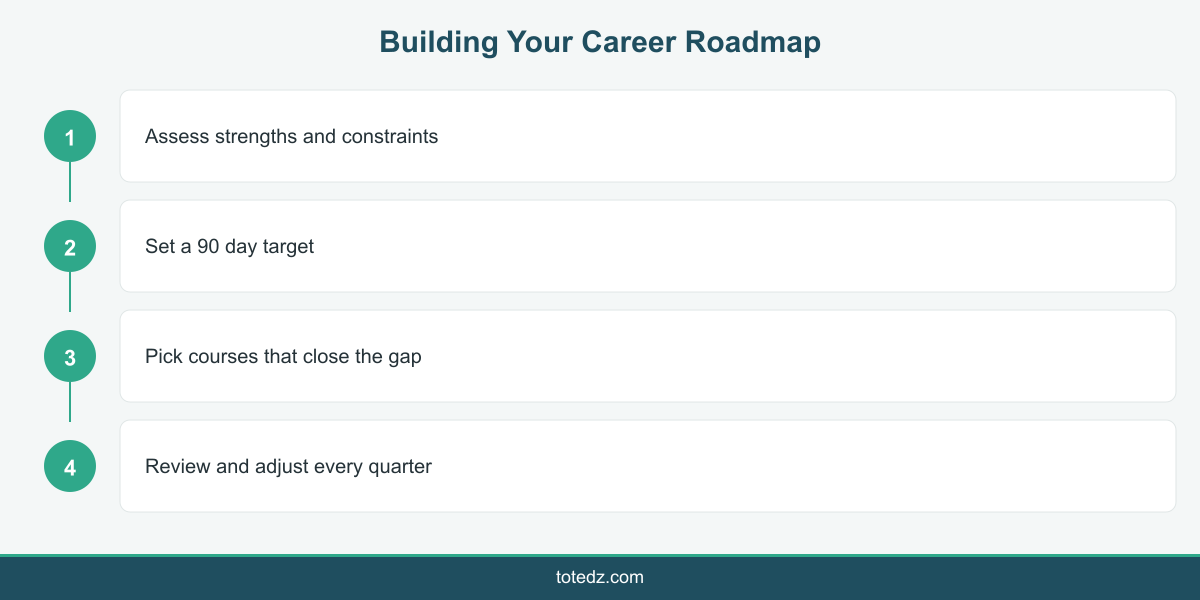
A career roadmap is the concrete output that turns guidance into action rather than a pleasant but forgettable conversation. At minimum it should include your target role or field, the specific skills gap between where you stand today and that target, the courses or certifications that close that particular gap, and a rough but realistic timeline attached to each step. Without a written roadmap, most guidance conversations fade within a few weeks simply because there is no document left to hold yourself accountable to once the initial motivation wears off.
Good roadmaps also build in regular checkpoints rather than functioning as one long, static document. Rather than committing to a single twelve month plan written once and never revisited, break it into ninety day blocks, each one ending with a concrete, checkable output such as a completed certification, a finished project, or a defined number of applications sent out. Career planning research generally supports shorter review cycles over long, static plans, since both the job market and your own interests can shift faster than an annual plan written in January can reasonably account for.
Keep the roadmap somewhere you will actually see it regularly, rather than a file created once and forgotten. A simple document with your target, your current block's goal, and a date for the next review works better in practice than an elaborate plan that is too complicated to update honestly each quarter.
Choosing the Right Courses and Certifications Along the Way
Once a roadmap identifies a specific skills gap, the next decision is which courses actually close it rather than simply looking impressive on a certificate wall. This is where a lot of otherwise good guidance breaks down in practice: a mentor can correctly tell you that you need data analysis skills for your target role, but choosing between a short certificate, a full length bootcamp, or a formal degree still requires comparing course quality, format, and total cost against your specific timeline.
Cost comparisons should also account for time, not just fees. A cheaper course that takes twice as long to complete may cost you more in delayed earning potential than a slightly more expensive option that gets you job ready sooner, particularly if your roadmap has a defined target date attached to it.
Academic vs Skill Based Learning
Vocational and skill based education tends to get you job ready faster for a specific, well defined role, while formal academic routes build broader foundations that tend to pay off over a longer career rather than the first job alone. Neither approach is universally better than the other. The right choice depends heavily on how quickly you actually need to become employable and whether your target role rewards depth in one area or breadth across several first.
How to Avoid Wasting Time and Money
Before enrolling in any course, check three specific things: whether the syllabus genuinely matches the skill gap identified in your roadmap, whether the format realistically fits your existing schedule and commitments, and whether past learners have actually gone on to relevant roles afterward. A mentor or counsellor can usually sense check a shortlist of two or three options faster, and more reliably, than you can research each one alone from scratch.
How Totedz Brings Guidance and Course Discovery Together
Totedz works as a course discovery platform where academies and institutes list their programs and students find the right one with the help of a dedicated counsellor, rather than searching course catalogues alone with no way to tell which listing actually fits their situation. That structure exists because guidance and course selection are really one connected decision, not two separate problems: the right course only makes sense in the context of a roadmap a mentor has already helped you build around your specific goals.
In practice this means a student can start with a counselling conversation, come away with a written roadmap, and then browse relevant courses on the same platform rather than restarting the entire research process from zero on a different, unconnected site. Continuing education tends to work best when the guidance layer and the course catalogue are connected like this, instead of being treated as two entirely separate problems that a student has to solve independently and then somehow reconcile.
Academies and institutes listing on the platform benefit from this connection too, since students arrive with a clearer sense of what they are looking for, having already worked through an assessment with a counsellor before browsing available programs.
Getting Started: Your First Steps With Totedz
If you are starting from scratch with no clear direction yet, the simplest first step is a short conversation with a counsellor to map out where you currently stand and what direction is realistic given your specific background, budget, and constraints. From there, ask explicitly for a written roadmap rather than a purely verbal recommendation you have to remember accurately, so you have something concrete to work from and revisit at each ninety day checkpoint.
You can also read more about how Totedz works before your first session, so you arrive with specific, informed questions rather than a general request for direction that could apply to almost anyone. The clearer your starting questions are, the faster a counsellor or mentor can move you from confusion toward a working plan you can actually begin executing the same week.
Whichever platform or counsellor you choose, treat the first session as the start of a process rather than a one time fix. The students who get the most out of career guidance and mentorship are the ones who show up to follow up sessions with real progress to discuss, not just the ones who ask the sharpest questions in the very first call.
Conclusion
Career guidance and mentorship work best when they are treated as one connected process: an honest assessment, a mentor or counsellor who challenges your assumptions rather than just agreeing with them, a written roadmap broken into short checkpoints, and courses chosen to close a specific gap rather than picked at random because they looked interesting. Students who skip the guidance step and jump straight to enrolling in courses tend to spend more time and money correcting course later than they would have spent getting guidance up front. Start with a conversation, get a roadmap, then choose your courses with that roadmap already in hand. Talk to a Totedz counsellor today to build yours.
Frequently Asked Questions
What is the difference between career guidance and mentorship?

How much does a career mentorship program typically cost in India?
Can online career counselling be as effective as in person sessions?
How often should I revisit my career roadmap?
Do I need a mentor if I already know which field I want to enter?
What should I bring to my first career counselling session?
How is Totedz different from just browsing course listings?
Is career guidance only useful for students, or also for working professionals?
How do academies get involved with Totedz for placement pipelines?