AI Courses Online: A Complete Guide to Tech Skills
 General
Searching for ai courses online usually starts with one question: which skill actually gets you hired. This guide covers the full tech skills landscape, generative AI, data science, cloud, and cybersecurity, and how a counselor-guided marketplace like Totedz helps you pick the right one instead of guessing from a catalog page.
What This Guide Covers
Jump to any topic: where beginners should start with generative AI tools, whether learning to prompt AI systems is worth the course fee, how to pick the right data analytics program, how a structured data program compares to a one-off certification exam, generative AI for career growth, machine learning basics for beginners, cloud computing career paths, building job-ready cybersecurity skills, and the data engineering career outlook.
Why Tech Skills Matter for India's Job Market Right Now
India's technology hiring has shifted fast. Roles that barely existed five years ago, prompt engineer, data analyst, cloud support specialist, now appear regularly in entry level job postings from Bangalore to Kochi. NASSCOM has tracked this shift closely, and the pattern is consistent: employers increasingly hire for demonstrated skill over degree pedigree, which is exactly why the right course matters more than the right college.
For learners outside the big four tech hubs, this is genuinely good news. A well chosen online course closes most of the gap that used to require relocating to a metro city. It does not close all of it. Local hiring demand in Kerala still concentrates around IT parks in Kochi and Thiruvananthapuram, and a course chosen without that context can teach skills that are technically correct but poorly matched to what nearby employers are actually recruiting for.
Government backed programs through Skill India have also expanded access to structured training, though eligibility and course depth vary widely. The practical takeaway is not that any single source, government or private, has all the answers, but that cross checking a course against real local job postings before enrolling is worth the extra hour it takes.
The shift also shows up in how job descriptions are written. Postings that once asked for a specific engineering degree now frequently list a skill and a portfolio requirement instead, a change that quietly favours anyone who can prove capability through a project rather than a transcript. This is precisely the opening that a well chosen course, followed by real applied work, is built to fill.
There is also a timing dimension worth naming plainly. Tech hiring in India moves in waves tied to global demand, and a specialization that looked saturated eighteen months ago can open up again as companies restructure their teams. Cybersecurity is a clear current example: after several quiet years, demand has picked up sharply as data protection rules tighten across sectors. Waiting for a skill to feel fashionable before learning it usually means arriving after the easiest hiring window has already closed.
What Actually Makes a Course Worth Its Fee
Course marketing pages tend to look remarkably similar to each other: a promise of job readiness, a list of tools covered, and a handful of testimonials. What they rarely show upfront is the thing that predicts outcomes most reliably, how much structured feedback a learner actually receives while working through the material.
A course with recorded video lectures and no review of your work will teach concepts. It will rarely correct the small, specific mistakes that keep a beginner's first project from being portfolio ready, an inefficient query, a poorly labelled dataset, a prompt that works once but not reliably. That correction loop is usually the actual difference between a course that leads to an interview and one that leads to a certificate sitting unused in an inbox.
Before enrolling in any AI or data program, it is worth asking three blunt questions directly to the provider: who reviews submitted work, how quickly, and what happens if a learner falls behind. Providers confident in their outcomes usually answer this without hesitation. Providers who cannot answer it clearly are often selling access to content rather than a path to a job.
How a Totedz Counselor Helps You Navigate This
A course catalog cannot tell you whether a machine learning certification is overkill for the analyst role you actually want, or whether a shorter cloud computing course would get you interview ready faster. That judgment call is exactly where a marketplace built around mentorship earns its place. Totedz connects learners with counselors who have seen which graduates from which course formats actually convert into interviews, not just certificates.
This matters more in tech than almost any other category on the platform, because the tech course market is saturated with options that look nearly identical on a landing page but differ enormously in depth, mentor access, and project quality. Browsing all courses without that filter wastes both time and course fees. This kind of comparison shopping applies well beyond tech too, which is why choosing the right online learning platform in general is worth reading before you narrow down to any single course.
What Local Academies Bring That a Generic Platform Cannot
Global MOOC platforms teach the same syllabus to a learner in Kochi and a learner in Toronto, which is efficient but not always useful. A locally listed academy, by contrast, often understands which specific employers in Kerala are hiring for a given tech skill this quarter, because their own placement pipeline depends on getting that right. This is one of the quieter advantages of a marketplace model over a single global course provider: the academies competing for enrollment on the platform have a direct incentive to stay current with local demand.
This does not mean a global provider's course is automatically the wrong choice. It means weighing local relevance explicitly rather than assuming a bigger brand name produces a better regional outcome. A counselor who works across many academy listings on Totedz is well placed to make that comparison directly. Totedz
Certificates vs Demonstrated Skill
It is worth being direct about something the course industry rarely states plainly: a certificate of completion proves attendance, not competence. Two learners can finish the identical course, one having engaged deeply with every exercise and one having watched videos on double speed to reach the end screen, and both receive the same certificate.
Hiring managers who have reviewed enough resumes tend to discount certificates for exactly this reason and weight demonstrated work far more heavily. This is not an argument against earning certificates, many job applications still filter on their presence, but an argument for treating the certificate as a byproduct of real learning rather than the actual goal. A course chosen specifically because it forces a reviewed project, not just a final quiz, is the more reliable investment of the two.
Choosing Your Track: A Comparison Framework
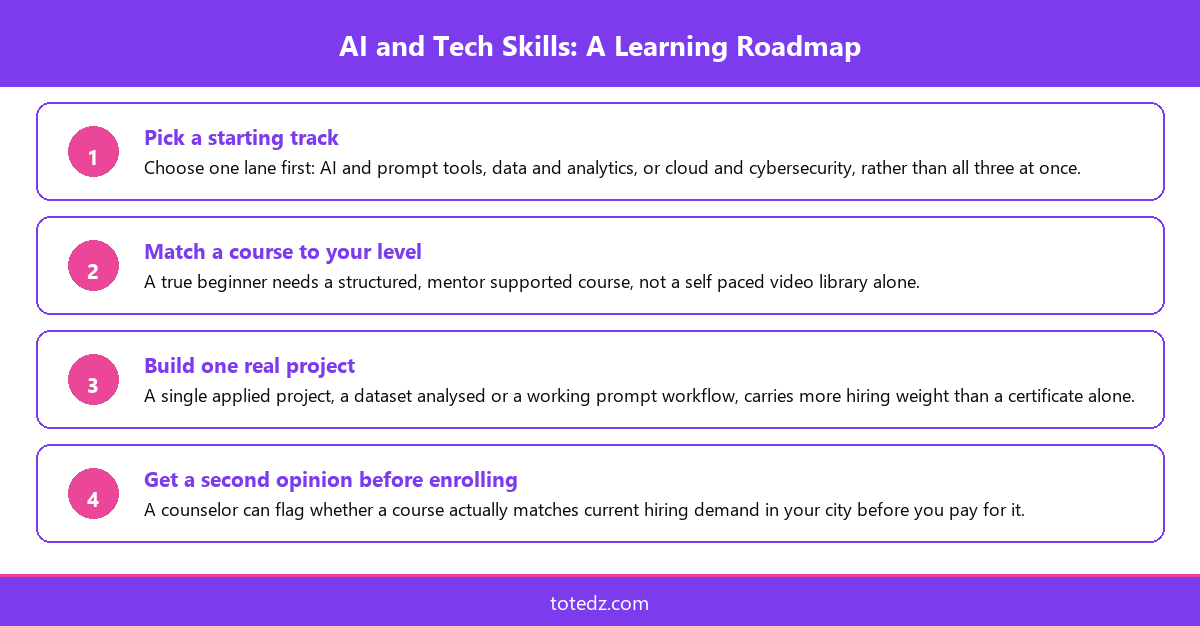
Most learners entering this space try to learn everything at once, a bit of AI, a bit of data, a bit of cloud, and end up with shallow exposure to all three rather than real competence in one. The three broad tracks above rarely require the same starting point or the same personality fit.
Fast movers who enjoy experimenting tend to do well starting with generative AI and prompt work, since feedback loops are immediate. Structured thinkers who are comfortable with numbers usually find data science and analytics a more natural entry, because the discipline rewards patience with fundamentals before any flashy output appears. Infrastructure minded learners, people who like systems that just need to keep working, tend to gravitate toward cloud and cybersecurity, where demand has stayed steady even through hiring slowdowns elsewhere in tech.
None of these tracks are mutually exclusive over a full career, but starting all three at once is the fastest way to finish none of them. A more realistic pattern: reach genuine competence in one track within three to six months, build a project inside it, then layer in adjacent skills as the job demands them. Employers rarely expect a junior hire to know everything; they expect one area done well.
A Learning Roadmap: From Curiosity to Career
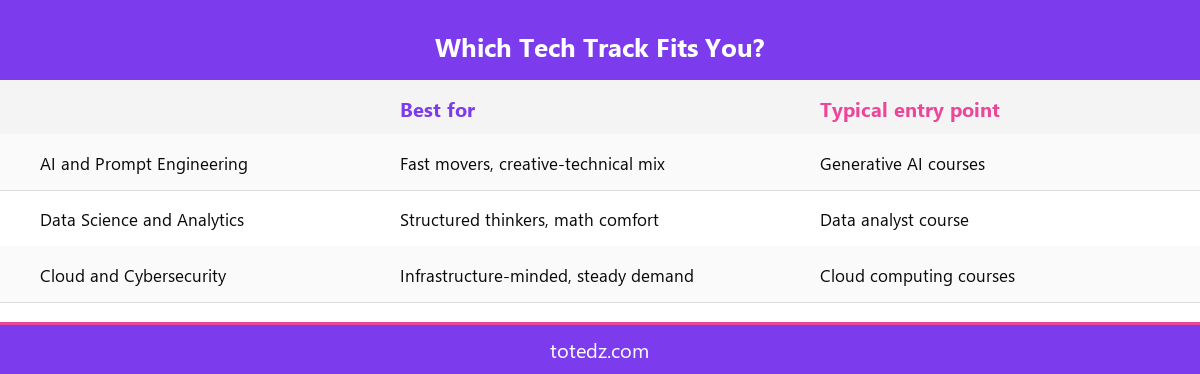
The roadmap above deliberately places course selection after track selection, not before. Picking the course first and the track second is the single most common reason learners abandon a program partway through, since the material simply does not match what they expected to be learning.
A single completed, well documented project also carries more real weight with hiring managers than an extra certificate. Employers reviewing junior applicants increasingly ask to see the project itself, a dashboard built, a model trained, a prompt workflow deployed, rather than taking a certificate's word for it.
The fourth step, getting a second opinion before enrolling, is the one most learners skip entirely, usually because it feels like an unnecessary delay. In practice it is the cheapest insurance available against the most expensive mistake in this whole process: paying for and completing a course that was never going to match local hiring reality in the first place. A fifteen minute conversation with someone who has already seen where a given course format leads is a small cost against months of study time.
Common Mistakes When Choosing an AI or Data Course
- Enrolling in an advanced generative AI course without first confirming basic Python or spreadsheet comfort, then struggling to keep pace.
- Choosing a course purely on certificate branding rather than checking whether it includes a reviewed, portfolio ready project.
- Assuming every AI courses online listing includes mentor support, when many are entirely self paced with no feedback loop at all.
- Ignoring local hiring context and training for a specialization with little demand in your own city or region.
- Comparing course prices without comparing course length and depth, so a shorter, shallower program looks like better value than it actually is.
- Treating the first course completed as the final word on a track, rather than as a starting point that a mentor can help refine.
Read more on artificial intelligence as a field if the terminology across course listings feels inconsistent between providers; a shared baseline understanding makes it much easier to compare two competing course descriptions honestly.
Signals Worth Checking Before You Enroll
Beyond the course itself, a handful of outside signals help confirm whether a track is actually worth pursuing in your specific city or region right now, rather than in the aggregate national picture that most course marketing pages quote.
- Search current job postings on major platforms for the exact skill, not just the broad category, and note how many are entry level versus requiring years of experience.
- Check whether local academies or institutes on a platform like Totedz are actively placing graduates from a given track, which is a more current signal than a course's own historical completion numbers.
- Ask a counselor whether recent enquiries have skewed toward one track over another, since that reflects live demand rather than a static industry report.
None of these signals alone is decisive, but together they replace guesswork with something closer to evidence, which is the entire point of treating this as a career decision rather than a hobby purchase.
How Long This Actually Takes
Course marketing often compresses timelines to sound more attractive than the honest picture. A generative AI or prompt focused track can produce a usable portfolio piece within four to six weeks for a motivated learner working part time. A full data science or data analytics track, covering statistics, a programming language, and a real dataset project, more realistically takes three to five months. Cloud and cybersecurity tracks sit somewhere in between, often four to six months to reach a genuinely interview ready standard rather than a merely familiar one.
These ranges assume consistent, part time study, roughly six to eight hours a week, not sporadic bursts followed by long gaps. Learners who study in short, frequent sessions retain more than those who cram occasionally.
Setting a realistic timeline before starting also protects against the most common reason learners abandon a course partway: comparing their own week four progress to someone else's month four result and concluding, incorrectly, that they are behind.
Conclusion
The fastest path through ai courses online is rarely the course with the most reviews or the lowest price. It is the one matched to a track you have actually chosen, a project you can point to afterward, and, ideally, a counselor who has seen where that specific course format leads. Browse tech courses on Totedz or talk to a mentor before committing to a program. For the broader question of which learning platform to trust before narrowing to any course, see our platform comparison guide.
Frequently Asked Questions
What should I look for first in ai courses online?

Do I need a coding background to start in AI or data science?
How long does it typically take to become job ready in a tech track?
Is a machine learning certification worth it without prior data experience?
Are cloud and cybersecurity roles still in demand in India?
How does Totedz help me choose between competing course options?
Can I switch tracks after starting one, for example from data to cloud?
Where can I browse the full range of tech courses on Totedz?