AI Courses Online: Where to Start in 2026
 General
Every ai courses online search page now looks identical: dozens of programs promising the same outcome. This guide narrows that field down to a single, workable starting point for 2026, based on what actually gets beginners hired rather than what gets the most clicks. For the fuller landscape across every tech specialization, see our complete tech skills starting guide.
Start With One Use Case, Not the Whole Field
Artificial intelligence as a subject is too broad to learn in order. Trying to cover machine learning theory, generative tools, and automation all at once in a beginner course is the fastest route to finishing none of it. A far more effective starting point is one narrow use case: writing and refining prompts for a specific task, summarising documents, drafting content, analysing text, that you can practise daily.
This is also why the most useful beginner programs increasingly separate prompt-focused training from deeper technical tracks. Learning to work with AI tools productively does not require the same math background as building models from scratch, and courses that blur this distinction often lose beginners in the first two weeks.
Three False Starts to Avoid
- Signing up for a comprehensive twelve week AI syllabus before confirming basic comfort with the tool you'll actually use daily.
- Choosing a course based on which AI model it teaches, when most core prompting skills transfer easily between tools.
- Trying to learn AI theory before AI use, which delays the practical confidence that keeps most beginners motivated past week two.
Each of these mistakes shares a root cause: starting with the course's structure instead of your own use case. Reversing that order, picking the task first and the course second, consistently produces better completion rates among beginners.
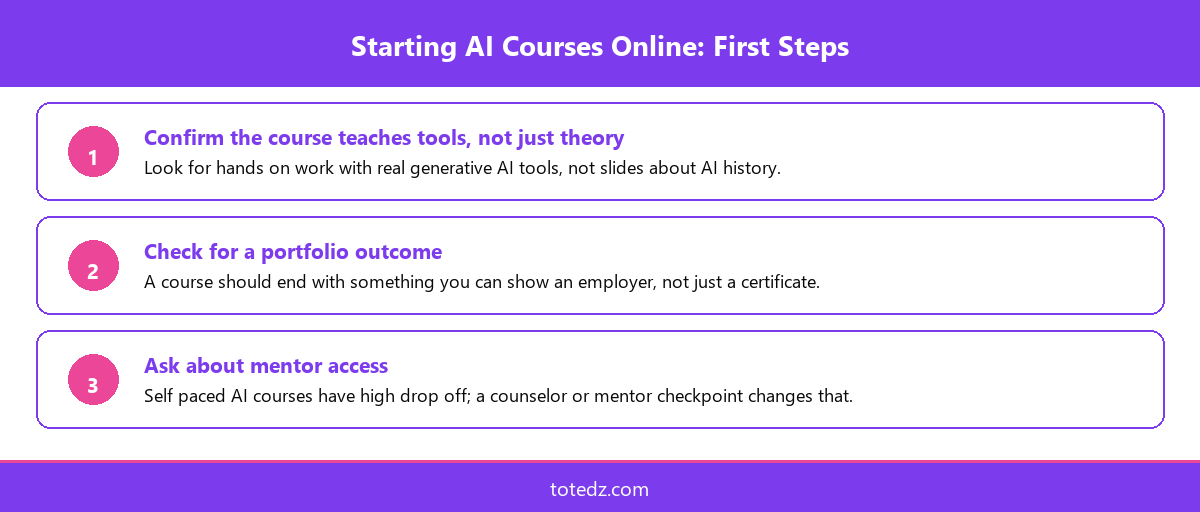
First Steps at a Glance
Why 2026 Specifically: The India Hiring Angle
India's tech hiring in 2026 has moved past treating AI familiarity as a bonus skill; it now appears as a baseline expectation in job descriptions across marketing, operations, and analyst roles, not only engineering. NASSCOM data has repeatedly flagged this shift, and Kerala's own IT corridor around Kochi has followed the national pattern with a lag of roughly one to two hiring cycles, meaning skills that are already standard in Bangalore are still a differentiator locally right now.
That lag is an opportunity, not a warning. A learner who builds a credible AI skill this year is competing against a smaller pool of similarly prepared candidates locally than the national numbers would suggest.
The practical effect shows up most clearly in interviews rather than job postings themselves. Candidates who can describe one specific AI-assisted task they have actually completed, not just list a tool name on a resume, are still uncommon enough in regional hiring pools to stand out immediately. That gap closes every year as more graduates enter with baseline AI exposure, which is the strongest argument for starting now rather than waiting for a more convenient moment.
How a Totedz Counselor Helps You Decide
A course listing page cannot tell you whether your specific goal, say, moving from a customer support role into a data adjacent one, is realistically served by a four week prompt course or actually needs a longer analytics track first. This is the exact judgment a Totedz counselor is positioned to make, having seen where graduates from different course formats have actually landed afterward.
If your interest sits closer to structured analysis than creative tool use, it is worth comparing this path against a full data analytics program before committing, since the two build genuinely different skill sets despite both getting marketed loosely as AI courses online.
This distinction trips up more beginners than any other single factor. Prompt-focused skills and data analytics skills often sit in the same course category on a listings page, use overlapping vocabulary in their marketing, and yet lead to almost entirely different day to day work. A short conversation before enrolling resolves this ambiguity far faster than trying both course previews and guessing from the syllabus alone.
A Realistic First Month
- Week 1-2: learn core prompting patterns on one tool, not several, and practise on real tasks from your current job or studies.
- Week 3: build one small, complete deliverable, a document summary workflow, a content draft process, something you can show, not just describe.
- Week 4: get feedback on that deliverable from a mentor or counselor and decide whether to go deeper into this track or pivot toward a more technical one.
This sequence deliberately delays deciding on a longer program until after a small real output exists, since that output tells you far more about fit than a course syllabus does.
Conclusion
Starting in AI does not require picking the biggest, most comprehensive course available. It requires picking one narrow, practical use case, building something real within it quickly, and only then deciding where to go deeper. Browse beginner-friendly tracks on Totedz or talk to a mentor to map out which starting point fits your current role. If you are still weighing which learning platform to trust in general, our guide to choosing an online learning platform covers that broader decision.
Frequently Asked Questions
Is 2026 a good year to start learning AI tools from scratch?

Do I need a technical background to start with generative AI tools?
How is this different from a prompt engineering course specifically?
What if I am not sure whether I want a technical or non-technical AI path?
Can a counselor help me even before I choose a course?
How does Totedz verify which courses are actually beginner-friendly?