Best Career Guidance Resources and Websites for Students
 General
Searching for career guidance websites for students turns up hundreds of results, most of them generic listicles with no clear way to actually act on the advice given. This guide curates the resources genuinely worth your time, grouped by what each one is actually good for, so you can build a working shortlist instead of endless open browser tabs.
Key Takeaways
Government career guidance websites for students are the most reliable source for verified schemes, courses, and labour market data.
General advice sites are useful for background research but rarely replace a real conversation with a trained counsellor.
A career development platform that combines counselling with course discovery saves significant time over checking many separate sites.
Government Career Guidance Resources
For verified, unbiased information, government platforms are the strongest possible starting point. The National Career Service lists job opportunities, skill development schemes, and career counselling access points run directly by the Government of India, while the Ministry of Skill Development and Entrepreneurship covers national skilling initiatives relevant to almost every field a student might consider.
These platforms are especially useful for confirming whether a scheme or subsidy you have heard about secondhand is actually real and currently active, since misinformation about eligibility and deadlines spreads quickly through informal channels.
Bookmark these specific pages rather than relying on a general search each time, since government site structures change periodically and a saved, outdated link can lead you to the wrong page months later.
Skill Development and Certification Bodies
The National Skill Development Corporation tracks accredited training partners and certification standards across industries, which is genuinely useful when you want to confirm whether a specific course or certification is properly recognised before enrolling and paying for it. The University Grants Commission plays a similar verification role specifically for degree level programs.
Checking a course against these bodies takes only a few minutes and can save considerable disappointment later, particularly for certifications you plan to use as a credential when applying for jobs or further study.
If a provider is not listed and cannot clearly explain why, treat that as a reason to ask more questions before enrolling, rather than assuming the omission is simply an administrative gap.
This check matters most for certifications you intend to use formally, such as on a resume or in a job application, since an unrecognised credential can undermine an otherwise strong application in ways that are easy to avoid.
General Career Advice and Research Sites
General career advice sites and guides offer well researched background on resumes, interviews, and workplace skills, which makes for useful reading before a counselling session rather than a substitute for one. Treat these resources as preparation material to bring questions from, not as a replacement for advice tailored to your specific background.
These sites work best when you use them to generate specific questions rather than final answers. Reading a general article on interview skills, for example, is more useful when it leads you to ask a counsellor how that advice applies to your particular field.
Counselling and Mentorship Platforms
General resources answer broad questions reasonably well but cannot assess your specific situation the way a real conversation can. A career development platform that connects you with an actual counsellor closes that particular gap, turning general research into a plan built around your real background, budget, and timeline through structured career counselling online.
This is also where research from the other resource types above becomes actionable. A counsellor can help you weigh options you have already identified through government sites and general reading, rather than starting the search from nothing in the session itself.
How to Use These Resources Together
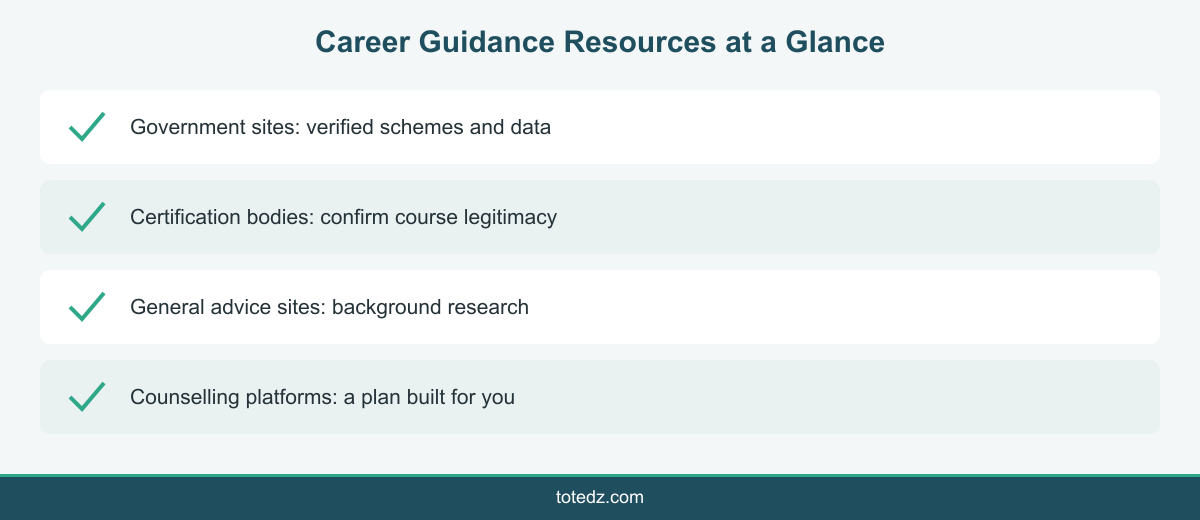
Use government and verification sites to confirm facts, general advice sites for background research and preparation, and a counselling platform to turn that research into an actual decision you can act on. Trying to make a final choice from research alone, without a conversation with someone who can assess your specific case, is the single most common reason students stall indefinitely at the research stage without ever moving forward.
A simple approach is to spend one focused week gathering information across these resource types, then book a counselling session to make sense of what you have found. Open ended research with no scheduled endpoint tends to continue far longer than it needs to.
Keep a running note of anything that surprises you during this week, whether it is a scheme you did not know existed or a course that turned out to be unrecognised. These specific surprises make for far more productive counselling sessions than a general summary of what you read.
A Quick Checklist Before You Trust a Resource
Before acting on advice from any career guidance website, run it through a short checklist: is the source government backed or independently verifiable, is the information current rather than several years old, and does it apply to the Indian context specifically rather than a general international audience that may not share the same schemes or job market conditions.
If a resource fails more than one of these checks, treat it as background reading only, and confirm anything important through a government platform or a direct conversation with a counsellor before it influences an actual decision.
Conclusion
The best career guidance websites for students are not a replacement for a real conversation but a way to prepare thoroughly for one. Use government platforms to verify facts, general advice sites for background reading, and a counselling platform like Totedz to turn that research into a concrete plan. Explore courses once your direction becomes clear.
Frequently Asked Questions
What is the most reliable career guidance website for Indian students?

Are free career guidance websites as good as paid counselling?
How do I verify if a course or certification is legitimate?
Should I trust career advice from social media over dedicated websites?
How often should I check career guidance resources for updates?
What makes a career development platform different from a single advice website?
Can international students use these same resources?
How do I know if a website's career advice is outdated?
Does Totedz replace the need to check other resources?
How can institutes list their programs as a trusted resource on Totedz?