Career Development Programs Worth Joining in India
 General
Career development programs range from a single weekend workshop to structured, multi month tracks with real mentorship built in, and the difference matters far more than the marketing copy usually suggests. This guide covers what to look for before joining one, so your time and money go toward a program that actually moves your career forward rather than just feeling productive.
Key Takeaways
The best career development programs combine structured content with real mentorship, not content delivery alone.
Check whether a program is genuinely built for your specific career stage rather than aimed at a generic audience.
A career development platform that lets you compare multiple programs in one place saves significant research time.
What Separates a Strong Program From a Generic One
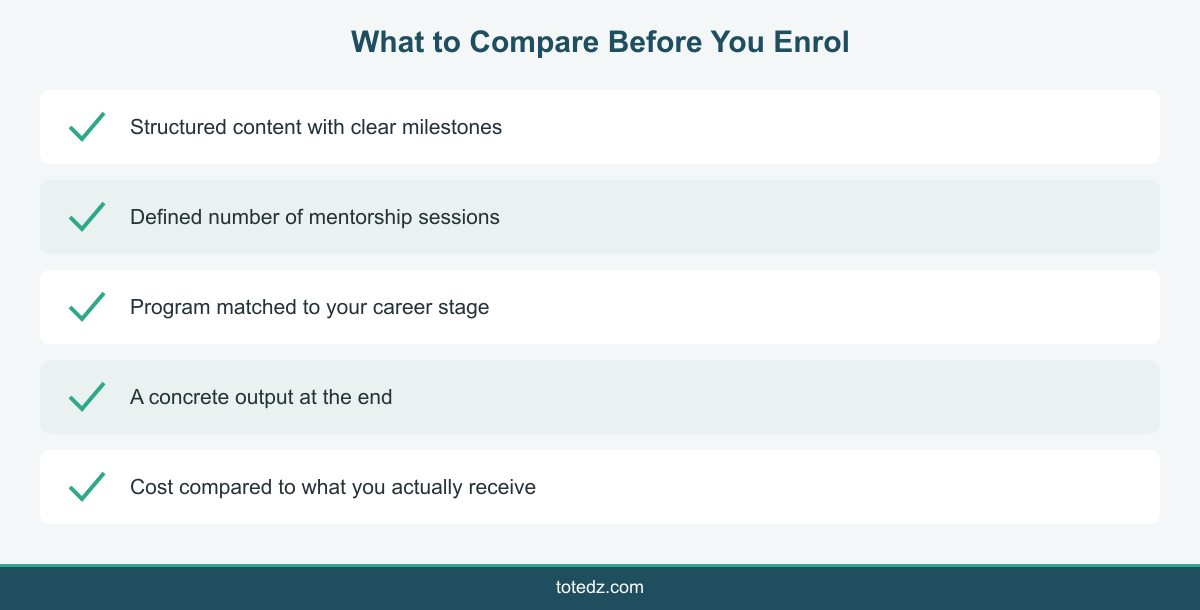
Strong career development programs combine structured content, such as skills training or a clearly defined curriculum, with mentorship that applies that content to your specific situation rather than leaving you to make the connection yourself. Programs offering content alone, without any personalised guidance layered on top, tend to have far lower completion and real world application rates.
A useful test is to ask what percentage of past participants actually completed the program and could point to a specific outcome afterward. Providers confident in their results are usually willing to share this; those who cannot are worth treating with caution. Continuing education research generally supports this pattern: structure paired with accountability produces meaningfully better completion rates than content alone.
Match the Program to Your Career Stage
A program designed for early career professionals will not serve someone with ten years of experience particularly well, and the reverse is equally true. Check the program's stated target audience and, where possible, ask to see the profile of recent participants before enrolling, to confirm it genuinely matches your actual career stage rather than a broad, generic description.
If a program markets itself as suitable for "all career stages," treat that as a reason for more scrutiny rather than less. Content genuinely useful to both a fresh graduate and a senior manager is rare, and the claim is often a sign the curriculum has not been tailored carefully.
Evaluate the Mentorship Component Specifically
Many programs mention mentorship prominently in their marketing without ever describing what it actually involves in practice. Ask how many one to one sessions are included, how mentors are matched to individual participants, and whether professional development courses within the program connect directly to the mentorship track or simply run alongside it as separate, unrelated tracks.
Also ask who delivers the mentorship specifically, since some programs use the instructors who built the content, while others bring in separate mentors. Neither approach is automatically better, but you should know which one you are actually paying for before you enrol.
Compare Cost Against What You Actually Receive
Price alone tells you very little on its own. Compare programs on session count, mentor quality, and whether you receive a genuinely usable output, such as a recognised certification or a written development plan, rather than comparing sticker price in isolation from everything else included. A cheaper program with no real structure often ends up costing more time overall once you factor in the results.
Where possible, ask for a breakdown of what the fee actually covers, session by session. A program that can explain exactly what you are paying for is generally more trustworthy than one that quotes a single bundled price with no detail behind it.
Use a Platform That Lets You Compare Options Directly
Researching career development programs individually across many separate institute websites is slow and makes any real comparison difficult. A career development platform that lists multiple programs alongside counsellor guidance lets you compare structure, mentorship quality, and cost side by side in one place before committing to any single option.
This also gives you a neutral party to sense check a shortlist against, rather than relying solely on each individual provider's own marketing to make the case for itself.
Once you have narrowed to two or three programs this way, a short conversation with a counsellor before final enrolment is usually enough to make the final call with confidence, rather than choosing on instinct alone.
Red Flags Worth Watching For
Be cautious of programs that lean heavily on guaranteed outcomes, such as promised salary increases or guaranteed placement, since no credible provider can honestly make that promise for every participant regardless of their starting point or effort.
Similarly, be wary of pressure to enrol immediately with no time to compare alternatives. Reputable programs are generally comfortable with prospective participants taking a few days to research and compare before committing.
Conclusion
The strongest career development programs combine real, applied content with mentorship matched to your specific career stage, not a generic workshop repeated identically for every audience. Compare programs on structure and mentorship quality rather than price alone, and use a platform built for direct comparison to save significant research time. Browse courses on Totedz to find a program that fits where you actually are.
Frequently Asked Questions
What is the difference between a career development program and a single course?

How do I know if a career development program is worth the cost?
Are career development programs only useful early in a career?
Can I join a career development program while working full time?
What should a good program include beyond content delivery?
How many mentorship sessions should a quality program include?
Should I choose a program based on the institute's brand name alone?
How is a career development platform different from a single institute's website?
Does Totedz offer career development programs directly?
How can an academy list its career development program on Totedz?