Career Guidance After Graduation: Your Next Steps
 General
The weeks right after graduation are when career guidance after graduation matters most, and also when it is easiest to freeze under too many competing options. This guide breaks down exactly what to do next, in order, so guidance turns into concrete action instead of an overwhelming, unranked list of possibilities.
Key Takeaways
The first two weeks after graduation should focus on assessment and research, not applications sent without any clear direction.
Career guidance after graduation works best when it results in a short, specific list of next actions, not general encouragement.
Delaying a decision to keep every option open usually costs more time in the end than committing to a direction and adjusting later.
Weeks One and Two: Assess Before You Act
Resist the strong urge to start applying everywhere immediately. Spend the first couple of weeks after graduation on honest assessment, similar to a structured career planning process, covering your genuine strengths, real interests, and practical constraints such as location and available budget for further study.
This period should also include talking to people already working in fields you are considering, since first hand accounts often reveal details about day to day work that no course description or job listing captures.
Write this assessment down rather than keeping it as a mental list, since a written version is easier to revisit honestly once you are further along and want to check your original reasoning against what actually happened.
Graduate unemployment data is a useful reality check during this period too. Broad awareness of which fields are genuinely hiring, versus which merely feel popular, can meaningfully sharpen the direction you narrow toward in the following weeks.
Weeks Three and Four: Narrow Your Career Options
Use your assessment to narrow broad career options after graduation down to two or three specific directions worth serious research. Research each one in enough depth to explain, in a single clear sentence, why it genuinely fits your background, not just why it happens to sound appealing in general terms.
Talk through your shortlist with someone else, whether a mentor, a family member, or a peer further along in a similar field. Explaining your reasoning out loud often reveals gaps in the logic that are much harder to notice while thinking it through silently.
Set a firm deadline for this narrowing step, such as the end of week four. Without one, research into career options after graduation can quietly stretch into months, delaying every stage that depends on it.
Month Two: Fill Skills Gaps With the Right Courses
Once a direction becomes clearer, identify the specific skills gap between where you currently stand and what your target roles actually require, then choose courses that close that exact gap rather than pursuing general upskilling with no clear target. This keeps month two focused rather than scattered across unrelated learning that feels productive but is not.
Track this month against a simple checklist: the specific skill you are targeting, the course chosen to build it, and the expected completion date, so progress stays visible rather than vague.
Month Three: Start Applying With a Clear Story
By month three you should be able to explain your direction clearly in an application or an interview, connecting your degree, your chosen courses, and your target role into one coherent, believable story. Applications sent with this level of clarity typically convert noticeably better than ones sent broadly without any clear connecting thread.
Keep a simple log of where you have applied and what you heard back, if anything. This makes it much easier to spot patterns, such as a particular type of role or company consistently responding, which can usefully sharpen your story further.
Where to Get Support Along the Way
You do not need to navigate any of this alone. Career guidance from a counsellor or mentor at each stage, from initial assessment through to interview preparation, shortens the overall timeline considerably and reduces the number of false starts most graduates go through without any support at all.
Support does not need to be expensive or elaborate to be useful. Even a single well timed conversation at the right stage, such as right before narrowing your options or right before your first applications go out, can meaningfully change the outcome.
If you are unsure where to start, a single introductory conversation is usually enough to identify which stage you actually need the most help with, rather than assuming you need support across the entire process at once.
A Simple Checklist for Your First 90 Days
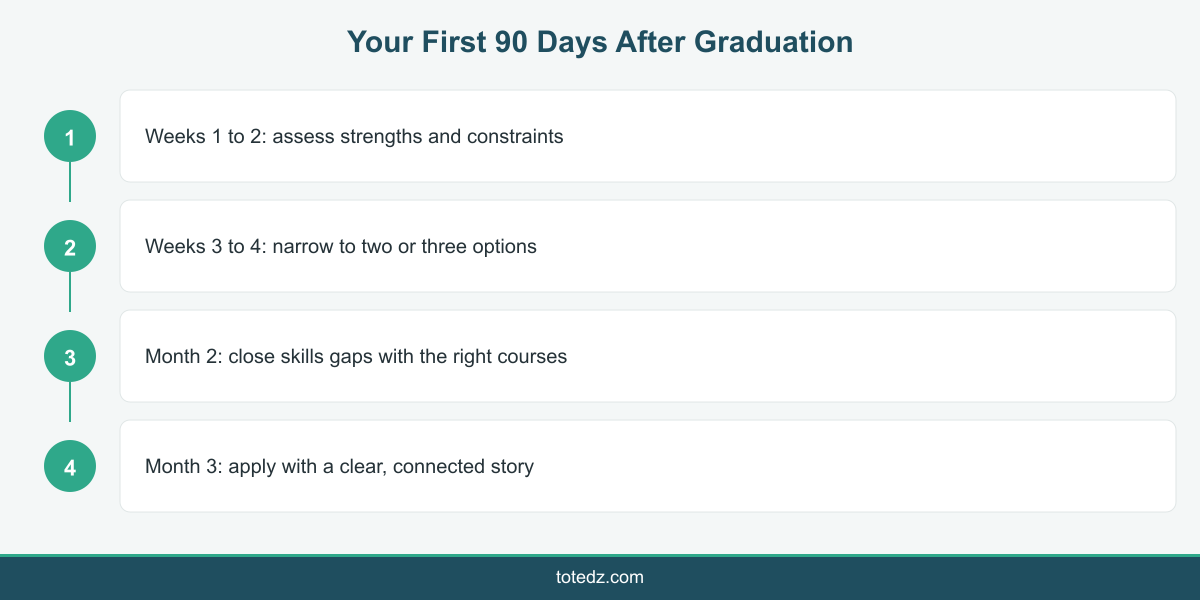
Use a short checklist to track progress rather than trusting memory alone: a written self assessment by week two, two or three narrowed directions by week four, a specific skills gap identified by month two, and at least one application sent with a clear story by month three.
If you reach any of these checkpoints without the expected output in hand, treat it as a signal to slow down and get support, rather than pushing forward on a plan that has quietly lost its footing.
Conclusion
Career guidance after graduation works best as a staged process: assess first, narrow your options deliberately, close specific skills gaps, then apply with a clear, connected story. Trying to do all of this at once, or rushing straight into applications, is what leaves most graduates stuck for months. Get matched with a Totedz counsellor to move through these stages with real support.
Frequently Asked Questions
Is it normal to not have a clear career direction right after graduation?

How long should I take before making a final career decision?
Should I take a break before starting career planning after graduation?
What if my chosen direction does not work out after a few months?
Do I need further courses immediately after graduation?
How do I explain a gap between graduation and my first role in interviews?
Can career guidance after graduation help with switching fields entirely?
Is it better to apply broadly or narrow down first?
How does Totedz support graduates in their first few months?
Can I get ongoing support beyond the first three months?