Course Finder: How to Choose the Right Course for Your Career
 General
A working course finder is not a search box with filters, it is a decision process. With thousands of options across dozens of fields, the hard part was never discovering that courses exist, it is narrowing them down to the one worth your time and money. This piece walks through that narrowing process step by step.
Why Filters Alone Do Not Solve This
Most platforms let you filter by price, duration, and rating, which narrows a list of thousands down to a list of hundreds, still too many to meaningfully compare. The missing filter is the one no dropdown menu can apply: whether a course actually matches your current skill level and your specific goal, not just the general subject area. Two people searching digital marketing might need completely different starting points, one already runs paid ad campaigns and needs advanced analytics, the other has never built a campaign at all.
This is also why star ratings mislead more often than they help. A four-and-a-half star average tells you the course satisfied most people who finished it, but says nothing about whether those people shared your starting point or your goal. A course rated highly by hobbyist learners exploring a subject casually may frustrate someone who needs job-ready depth within a fixed timeline, even though the star rating looks identical to both groups.
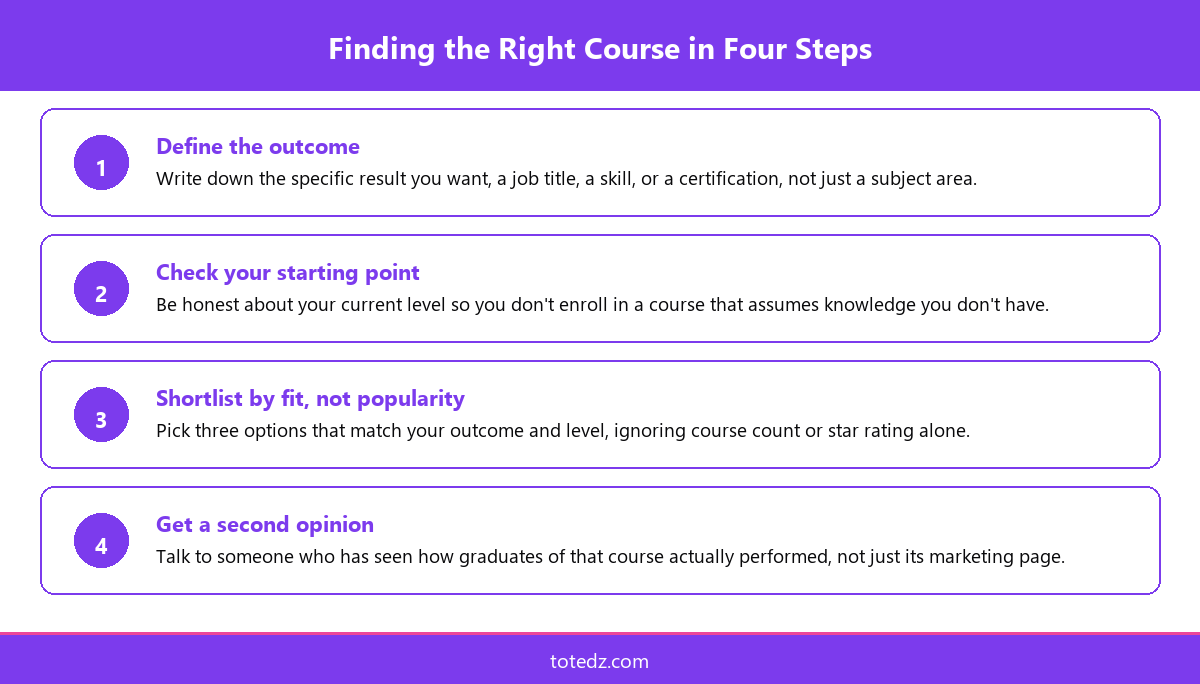
Step One: Define the Outcome, Not the Subject
Searching digital marketing course returns thousands of results because the subject is too broad to filter meaningfully. Searching for the specific outcome, becoming job ready for a performance marketing role within four months, immediately rules out most of those results. Write the outcome down before you start browsing, including a rough timeline, since a course that would be perfect with a year to spare is the wrong choice with six weeks left before a placement deadline.
This step matters even more in fast-changing technical fields. Someone narrowing down artificial intelligence or data-related options should treat course recency as part of the outcome definition itself, a question our separate resource on where to start with AI-focused learning addresses directly.
Step Two: Be Honest About Your Starting Point
The single most common enrollment mistake is picking a course pitched above or below your actual level. A beginner course will bore someone who already has working knowledge, while an advanced course will lose a true beginner within the first two sessions. Most course descriptions state a prerequisite level, but few learners read it carefully before enrolling, largely because the marketing copy above it is more persuasive than the fine print below it.
A quick, honest test helps here: try to explain the subject's core concept out loud, in your own words, for sixty seconds. If you can do it comfortably, a beginner course will waste your time. If you struggle within the first ten seconds, an advanced or intermediate course will lose you quickly. This small check catches more mismatches than reading course descriptions alone, because descriptions are written to sound approachable to the widest possible audience, not to accurately calibrate to your specific level.
Step Three: Shortlist by Fit, Not by Popularity
Once you have an outcome and an honest skill level, apply both as filters and keep only the courses that pass both tests, typically three to five options. Do not expand the shortlist just because a highly rated course does not match your level, a mismatched course with great reviews from a different audience will not serve you any better than a mismatched course with mediocre reviews.
Keep the shortlist visible somewhere you will actually revisit it, a simple note works fine, rather than relying on memory or browser tabs that get closed. Decision fatigue sets in quickly once you start reopening comparisons from scratch every few days.
Our separate comparison of leading platforms by category is a useful reference at this stage, since it groups options by what they are actually built for rather than by marketing claims.
Step Four: Get a Second Opinion Before Paying
Even a careful shortlist benefits from an outside view, ideally from someone who has seen how past learners of a specific course or academy actually performed afterward. This is the exact gap a counselor-matched course recommendation is built to close, since a counselor sees outcomes across many learners rather than just one course description.
What Good Platform Design Looks Like Once You've Narrowed Down
After you have a shortlist, the platform hosting each option matters too, not just the course itself. Our companion piece on what actually makes an education platform worth using covers the structural signals worth checking, things like whether doubt-clearing sessions exist and whether a syllabus is kept current.
If your course search is really part of a bigger, undecided career question, start one level up instead. Our guide to career mentorship for students and our piece on building a roadmap after graduation both address the broader decision that a single course cannot answer on its own.
Conclusion
A good course finder narrows thousands of options down to one that actually fits, using outcome and skill level as the real filters that a dropdown menu cannot apply. Follow the four steps above, and if you want a second opinion before you commit, reach out to a Totedz counselor to talk through your shortlist.