Generative AI Courses for Career Growth
 General
Employers no longer ask whether you have used an AI tool. They ask what you built with it, which is why interest in generative ai courses has grown faster than almost any other skills category on Totedz this year. This guide covers what these courses actually teach, what employers in India are hiring for, and how to pick one instead of guessing.
Key Takeaways
- Employers care more about applied output, a prompt library, a workflow you automated, than about a certificate alone.
- Demand for these skills is strongest where a specific business problem meets AI, not in generic AI awareness training.
- A counselor conversation before enrolling saves months compared to picking a course based on a course-listing page alone.
- Course curricula vary widely even within the same category, so the specific syllabus matters more than the course title.
What These Courses Actually Teach
Training in this category ranges from a two-hour overview of large language models to a multi-week program covering prompt design, retrieval-augmented workflows, and light fine-tuning. Overview courses help with orientation but rarely produce a hireable skill alone. For the underlying concepts explained simply, the Wikipedia entry on generative AI is a reasonable, free starting point before paying for a course.
The more valuable programs are built around a real deliverable: an automated content workflow, a working chatbot connected to a real dataset, or a documented before-and-after on a task you already do at work. That deliverable is what shows up in an interview, not the course completion badge.
A common mistake is treating every course as interchangeable because they mention the same handful of tools. A course built around marketing copy generation and one built around code assistance teach almost entirely different skills, even under the same label. Check the actual curriculum and sample projects before enrolling, not just the title.
India Job Market Context for These Skills
Hiring for applied AI roles in India is concentrated in a handful of patterns, not spread evenly. Product and content teams at mid-size companies adopt fastest, since the return on one automated workflow is immediate and easy to measure. Kerala's IT and BPO sector, in particular, now asks entry-level hires to show hands-on exposure to AI tools, even for roles that are not formally AI roles.
Salary impact tends to attach to the base role, not the AI skill alone. A support analyst or marketing executive who can demonstrably automate part of their workload usually commands a modest premium over a peer who cannot, rather than being reclassified into a separate, higher-paid title. Treat these courses as a multiplier on an existing career track, not a shortcut to a new one.
How a Totedz Counselor Helps You Decide
A course-listing page cannot tell you whether your role and industry are ready to reward this skill, or whether a different track would serve you better. A Totedz counselor looks at your actual job, your target companies, and the courses available on the platform, then narrows the choice to one or two options instead of comparing a dozen listings alone.
This matters most for career switchers, where the wrong first course can cost several months. If you are unsure where to start, a short conversation with the team before you enroll anywhere is worth more than another hour of comparing syllabi online.
If you are also weighing broader questions about which platform to trust for this kind of training, our guide to choosing between different online learning platforms walks through what to check before you pay for any course, generative AI or otherwise.
Getting Started Without Wasting Time
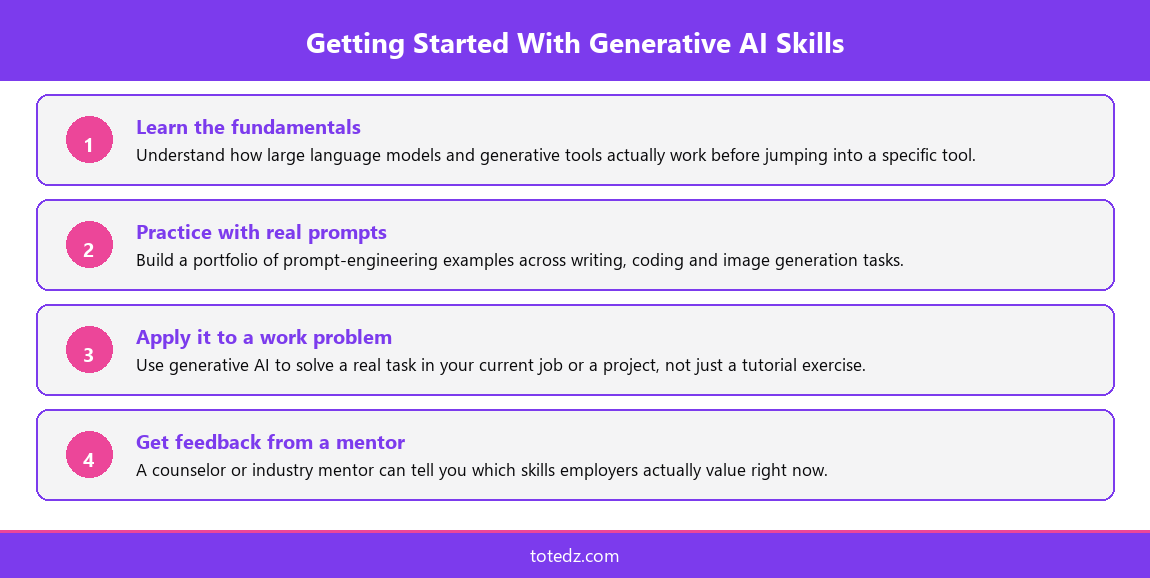
The sequence below is the order that produces a usable skill fastest, rather than the order most course catalogs present it in. Skipping straight to a specific tool without the fundamentals step usually means relearning concepts later once the tool changes, which it will. For a broader map of where to begin across AI skill areas, see our wider guide to AI courses online.
Conclusion
Generative AI skills reward people who can point to one concrete thing they automated or improved, not people who collected the most course badges. Start with the fundamentals, apply the skill to a real problem at work, and get feedback from someone who understands both the technology and the local job market. If you are weighing this against a more structured path, our beginner's guide to machine learning certification and our overview of data engineering career outcomes cover two close adjacent tracks. Browse the current course options on Totedz, or talk to a mentor before committing.
Frequently Asked Questions
What background do I need before starting a generative AI course?

Are generative AI skills only useful for tech roles?
How long does it take to build a hireable skill in this area?
Do I need a technical certification, or is a project portfolio enough?
How is Totedz different from a platform like Udemy or Coursera for this topic?
Is this skill area oversaturated with new learners right now?
Should I learn a specific tool or the underlying concepts first?
Where can I check how India's broader tech sector is approaching AI adoption?