How to Build a Career Roadmap After Graduation
 General
Graduation ends one clear structure and replaces it with dozens of open ended options, which is exactly when a career roadmap becomes genuinely useful rather than optional. This guide covers how to build a realistic one, step by step, so the freedom after graduation turns into a working plan instead of prolonged, expensive indecision.
Key Takeaways
A career roadmap after graduation should start with an honest assessment, not a list of jobs you feel you should want.
Break the roadmap into short blocks with concrete outputs rather than relying on one long, vague annual plan.
Revisit the roadmap regularly, since your first draft rarely survives contact with the actual job market unchanged.
Start With an Honest Assessment, Not a Wish List
Before mapping out career options after graduation, take real stock of your actual strengths, genuine constraints, and what you actually enjoyed or disliked during your degree, rather than what sounds impressive to list. Skipping this step and jumping straight to job titles is the single most common reason roadmaps quietly fail within a few months.
An honest assessment also means being specific about constraints such as location, family expectations, or financial pressure, since a roadmap that ignores these will look good on paper but be unworkable in practice once real decisions have to be made. Graduate unemployment research consistently shows that mismatched expectations, not a lack of effort, are behind many stalled job searches.
Narrow a Wide Field Into Two or Three Directions
Most graduates start with either too narrow a view, fixated on one specific role, or too broad a view, open to almost anything. Use your assessment to narrow down to two or three genuinely realistic directions, then research each one specifically rather than continuing to browse broadly without committing. Career guidance after graduation from a trained counsellor speeds up this narrowing process considerably.
Test each of your two or three directions against a simple question: can you name a specific first role and a specific skill gap for it. If you cannot, that direction likely needs more research before it belongs in your roadmap as a serious option.
Set 90 Day Blocks Instead of a Single Annual Plan
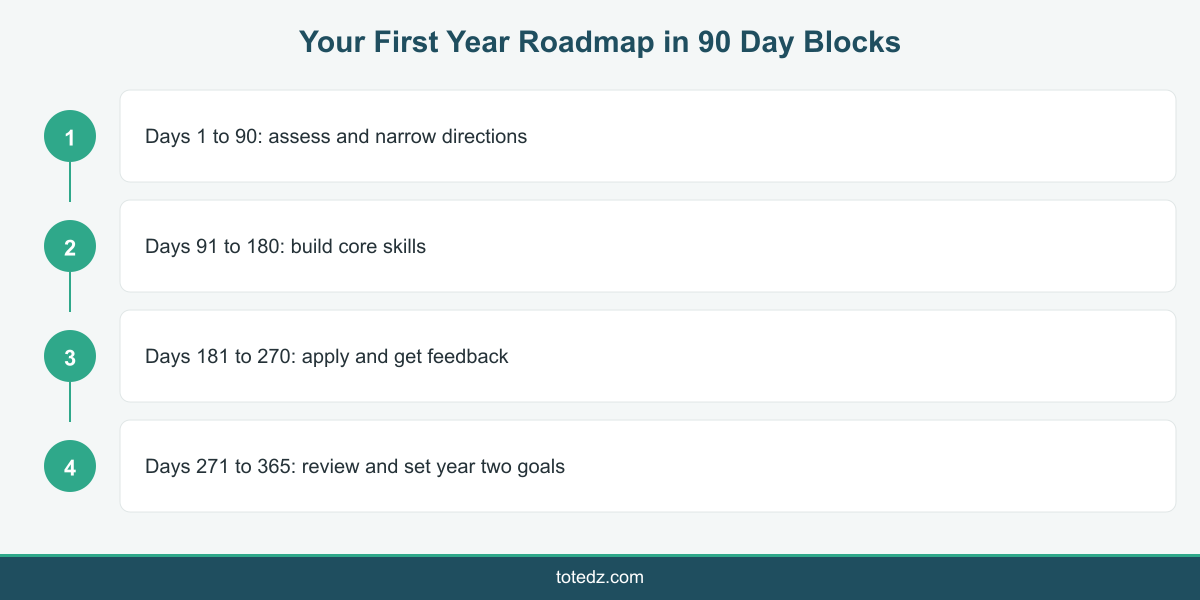
Break your roadmap into ninety day blocks, each one built around a single concrete output, such as completing a certification, finishing a project, or applying to a defined number of roles within that window. Shorter blocks make it far easier to notice early when a direction is not working and adjust course before too much time has already been invested in it.
At the end of each block, write a short honest review: what actually happened, what surprised you, and what you would change. This habit alone tends to improve decision making more than any single planning technique.
Keep each block’s goal genuinely achievable within ninety days. Overly ambitious blocks tend to get pushed back repeatedly, which quietly erodes confidence in the roadmap as a whole, even when the underlying direction is still sound.
Choose Courses That Match Your Roadmap, Not the Reverse
Once your direction becomes clearer, pick courses that close a specific gap identified during your assessment, rather than starting from an interesting looking course and building a plan around it afterward. This ordering keeps the roadmap driving your decisions, instead of an appealing course description quietly setting your direction for you.
Vocational education routes are often the fastest way to close a narrow, well defined gap, while broader courses make more sense when the gap itself is still not fully clear. Match the course format to how specific your gap actually is.
Review and Adjust Every Quarter
Treat your roadmap as a living document rather than a fixed contract with yourself. Review progress every quarter, and stay willing to revise the plan based on what you have actually learned, not just what you originally assumed when you first wrote it down months earlier. A mentor is particularly useful here, since they can help you tell the difference between a plan that simply needs patience and one that genuinely needs to change direction.
Put the review date in your calendar at the same time you write the roadmap, rather than leaving it as a vague intention. A scheduled review is far more likely to actually happen than one you plan to get to eventually.
Over several review cycles, you will likely notice your own patterns, such as consistently underestimating how long a block takes. Feed that back into how you plan future blocks rather than repeating the same overly optimistic estimate each quarter.
Common Mistakes That Derail a Career Roadmap
The most common mistake is writing a roadmap once, right after graduation, and never opening the document again. A roadmap that is not reviewed quickly stops reflecting reality, even if the original thinking behind it was sound at the time.
A second common mistake is making the plan too rigid, treating the first draft as a fixed contract rather than a working hypothesis. Graduates who build in review points from the start find it far easier to adjust without feeling like they have failed at the plan entirely.
Conclusion
A career roadmap after graduation works when it starts with an honest assessment, narrows quickly to a couple of realistic directions, and breaks the overall plan into short, reviewable blocks rather than one long guess. Treat the first draft as a starting point, not a final answer, and revisit it every quarter without fail. Talk to a Totedz counsellor to build your roadmap with real guidance instead of guesswork.
Frequently Asked Questions
How soon after graduation should I build a career roadmap?

What if my roadmap changes completely within a few months?
Should my roadmap focus on one career option or keep options open?
How specific should the courses in my roadmap be?
Is it normal to feel behind compared to classmates after graduation?
Can a career roadmap help with career options after graduation in an unrelated field to my degree?
How do I know if I should adjust my roadmap or push through a difficult phase?
Do I need a mentor to build a career roadmap, or can I do it alone?
How does Totedz help with career guidance after graduation specifically?
Can I revisit my roadmap with the same counsellor over time?