Machine Learning Certification: A Beginner's Guide
 General
Search for a beginner's path into applied AI and you will find dozens of certificate programs claiming to be the right first step. Most beginners do not fail because they picked a bad course. They fail because they picked the wrong certificate format, foundational, applied, or specialised, for where they actually stood. This guide separates the three before you spend money on any of them.
Key Takeaways
- There are three distinct certificate formats in this space, and most confusion comes from comparing across them, not within them.
- A specialised certificate without a foundational base usually wastes both the money and the time.
- Employers in India increasingly ask for a project, not just a certificate name, during interviews.
Three Certificate Formats, Not One
The phrase itself covers a wide range of programs, from a four-week statistics-and-algorithms overview to a six-month applied program ending in a deployed model. Confusing these formats is the single most common reason beginners feel lost. The Wikipedia overview of machine learning is a useful, free way to understand the field before comparing paid programs. If you are still deciding whether this is the right skill area to start with at all, our wider guide to AI courses online is a useful first stop.
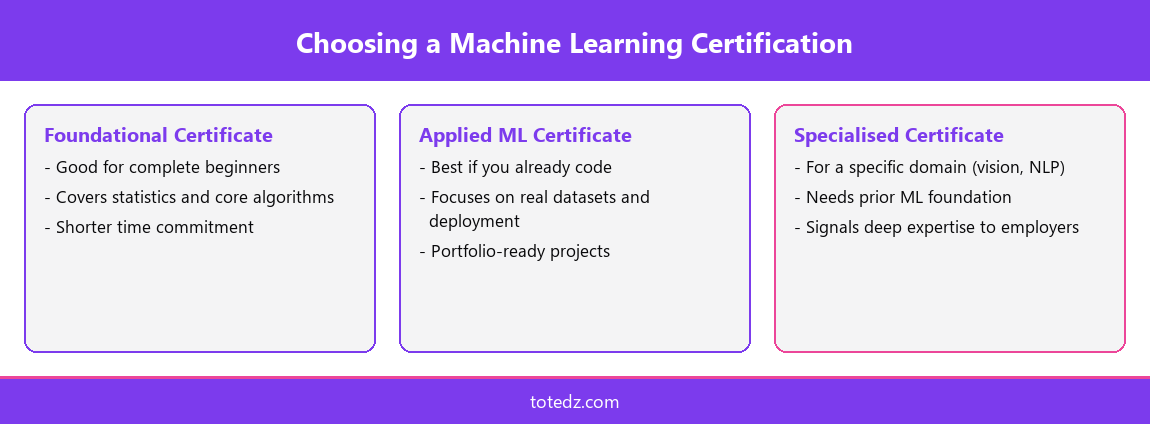
Foundational programs are for people with no prior exposure and focus on the statistics and algorithms everything else builds on. Applied programs assume that base exists and spend most of the time on real datasets, model evaluation, and deployment. Specialised programs, in computer vision or NLP for instance, assume both stages are in place and go deep into one narrow area instead of the whole field.
India Job Market Context Before You Choose
Entry-level machine learning roles in India are more competitive than course marketing suggests, and a certificate alone rarely clears the bar. What consistently moves candidates forward is a documented project on a real or realistic dataset, ideally tied to an industry the candidate is targeting, such as fintech, healthtech, or logistics, all with a visible hiring presence in Kerala's growing tech corridor.
Employers increasingly ask candidates to explain a model's limitations, not just its accuracy score. A certificate that only teaches you to run existing code, without explaining why a model fails, leaves a gap that shows up quickly in technical interviews.
This is where the gap between a foundational and an applied certificate shows up most sharply. A foundational-only candidate can describe an algorithm correctly but struggles to explain why it underperformed on a messy, real-world dataset, exactly the kind of question that separates candidates in a second-round interview.
How a Totedz Counselor Helps You Decide
Choosing between a foundational, applied, or specialised certificate depends on your skill level, target role, and how much time you can commit, none of which a course-listing page can assess. A Totedz counselor reviews your background against the courses available and recommends a starting point instead of leaving you to guess from a syllabus alone.
This guidance matters even more if you are also comparing certificate providers against each other, since marketing pages rarely disclose completion rates or how recent their curriculum actually is. If you're also weighing where to take the course itself, our comparison of online learning platforms covers what to check before you commit.
Counselors also flag a mismatch that course marketing rarely admits to: a specialised certificate purchased before the foundational and applied stages are solid enough. That sequencing mistake is the single most common reason a beginner spends money on a program and still cannot answer basic technical questions in an interview six months later.
A Realistic Starting Sequence
If you are starting from zero, begin with a foundational certificate before anything specialised, and pair it with a small project of your own rather than relying only on the course's built-in exercises. Give yourself six to eight weeks on this stage even if the course markets itself as shorter, since exercises alone rarely build lasting understanding without repetition.
Beginners further along and comfortable with basic statistics often do better skipping straight to an applied program, then pairing it with a specialised track once they know their target domain, covered in more depth in our guide to generative AI courses for career growth and our cloud computing career path guide for the infrastructure side of deployment.
Whichever stage you start at, resist enrolling in two overlapping programs at once. Beginners who split attention across a foundational and an applied course simultaneously usually finish both more slowly than if they had completed one fully first.
Conclusion
The right certificate format depends on where you are starting, not which program has the most reviews. Match the format to your starting point, build one real project alongside it, and get a second opinion before paying. Explore machine learning and AI courses on Totedz, or register to speak with a counselor first.
Frequently Asked Questions
Do I need a coding background before starting a machine learning certification?

How long does a beginner-level program typically take?
Is a free certificate as valuable as a paid one for job applications?
What industries in India are hiring most actively for entry-level ML skills?
Should I complete multiple certifications before applying for jobs?
How does Totedz help me avoid choosing the wrong certificate format?
Where can I read more about the broader IT sector's skilling priorities in India?