Online Training Platforms for Working Professionals
 General
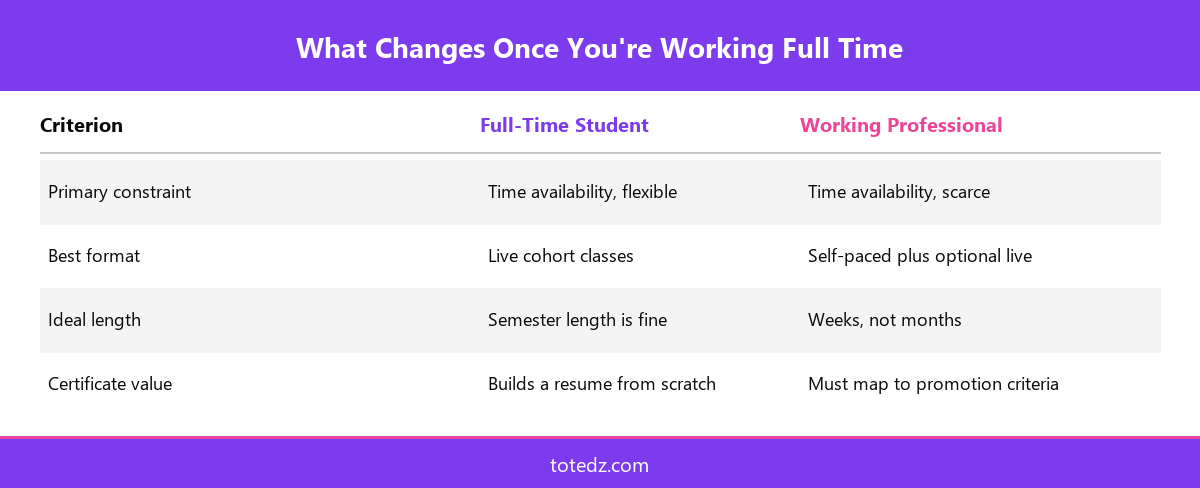
A working professional choosing an online training platform is solving a different problem than a full-time student. Time is the scarcest resource, not money or motivation, which changes almost every criterion that matters. This piece covers what to actually check before enrolling while employed full-time.
Why Student-Oriented Advice Does Not Transfer
Most course-comparison content is written with a student's schedule in mind: long stretches of free time, flexible daily routines, and a semester-length runway. None of that describes a working professional's week. Evening energy is limited after a full workday, weekends compete with family and rest, and a rigid weekday class schedule is often a hard dealbreaker rather than a minor inconvenience. Our broader comparison of leading learning platforms is a useful starting point, but the filters that matter most shift once employment status enters the picture.
The Three Filters That Actually Matter
Scheduling flexibility comes first. Self-paced content with recorded sessions available on demand beats live-only formats for most working learners, though some live doubt-clearing sessions, scheduled outside business hours, add real value without the rigidity of a full live curriculum.
Time-to-outcome comes second. A working professional rarely has the bandwidth for a sprawling, exploratory curriculum. Programs that state a clear, realistic completion timeline, and stick to it, respect a schedule that a student-oriented twelve-month program simply does not.
Career relevance of the certificate comes third. A credential only helps if it is recognized in your specific industry or by your current employer's promotion criteria, which is worth confirming before enrolling rather than assuming.
Professionals specifically upskilling toward artificial intelligence or data-related roles face an added twist, since course content in these fields can go stale within months rather than years, which is exactly the angle our separate guide to getting started with AI-focused courses is built to address.
Reading the Fine Print on Live Sessions
Platforms that advertise live sessions rarely specify the time zone or the exact recurring day upfront, details that matter enormously once you are trying to fit a course around a fixed job schedule. Before enrolling, confirm the actual session times against your own calendar for at least four consecutive weeks, not just the first one, since a program that looks compatible on day one can conflict with a recurring weekly meeting you forgot to check against.
Also confirm whether missed live sessions are recorded and made available afterward. A program with no recording policy effectively punishes a single bad week at work with a permanently missed module, which compounds quickly over a ten or twelve week course.
Employer-Sponsored vs Self-Funded Training
If your employer offers a learning stipend or sponsors specific certifications, check that list before researching independently, since sponsored programs often come with additional support such as manager check-ins or internal recognition that a self-funded course cannot replicate. Where no sponsorship exists, prioritize programs with a clear, verifiable return, a specific skill gap on your team, a stated promotion criterion, or a role you are actively trying to move into.
How This Connects to Broader Upskilling Strategy
Choosing a single training platform is really a small piece of a larger upskilling decision that also covers which skills to prioritize and how to sequence them across a career. Our companion pillar on workplace upskilling for employees and employers covers that broader sequencing question in depth, useful reading once you have settled on a platform and are thinking about what comes after this first course.
It is also worth revisiting the structural checklist in our piece on what actually makes a platform worth using, since the same signals, current syllabi, real instructor credentials, transparent refund policy, apply just as much to a working professional's choice as to a student's.
When a Certification Actually Moves a Career Forward
Not every certification carries equal weight, even within the same field. Certifications tied to a specific, widely recognized vendor or standards body tend to be checked directly by hiring managers and appear as explicit criteria in job postings. Certifications issued only by the training platform itself carry weight mainly when the platform's own brand is already respected in that specific industry. Before enrolling for career impact rather than personal interest, search a few relevant job postings in your target role and check whether the certification is mentioned by name, a five-minute check that tells you more than any marketing page.
A Realistic Weekly Time Budget
Before enrolling, write down how many hours per week you can realistically commit, accounting for a bad week, not just a good one. Most working professionals overestimate this number during a burst of initial motivation and then fall behind once the first busy sprint at work arrives. A program that fits four to six realistic hours per week will get finished. A program that requires ten hours but only gets four, most weeks, will not, regardless of how good the content is.
Conclusion
Working professionals need a different set of filters than students, built around scarce time rather than scarce money or motivation. Match the format, timeline, and certificate value to your actual week, and browse academy-led programs built for working schedules or talk to a counselor before committing to one.