Prompt Engineering Course: Is It Worth Learning?
 General
A prompt engineering course sounds like a narrow, almost gimmicky specialization to some and a genuine career skill to others. The honest answer sits in between, and depends heavily on what you already do for work. Here is how to tell which side you're on.
What This Skill Actually Involves
Despite the technical-sounding name, this discipline is less about programming and more about structured, testable communication with an AI system. Prompt engineering as a field covers techniques for getting consistent, accurate output from generative tools, chaining instructions together, providing examples, catching and correcting failure patterns, rather than relying on a single lucky phrasing.
This distinction matters because it changes who benefits most. Writers, marketers, analysts, and customer support staff who already communicate for a living tend to pick this up faster than expected, since the underlying skill overlaps heavily with clear written instruction.
It also means the skill is far less about memorising a list of clever phrases, the kind that circulate widely on social media, and far more about developing a repeatable process: state the goal clearly, give the system relevant context, review the output critically, and refine based on exactly what went wrong. Learners expecting a shortcut list are often disappointed; learners expecting a genuine, teachable process tend to find the material more useful than anticipated.
Demand for This Skill in the Indian Job Market
Job postings in India that explicitly name this skill remain concentrated in larger tech hubs, but the underlying requirement, comfortable, reliable use of generative AI tools, now appears embedded inside marketing, content, and support role descriptions across smaller cities too, including Kerala's IT corridors. It rarely appears as a standalone job title locally; it appears as one bullet point among several inside a broader role.
This changes how the skill should be positioned on a resume. Framing it as a standalone specialization works well in a handful of dedicated national roles, but for most learners in Kerala, framing it as an enhancement to an existing skill set, a content writer who can also structure AI workflows, an analyst who can also automate repetitive tasks, matches local hiring patterns more closely.
Who Should Actually Pay for a Course Here
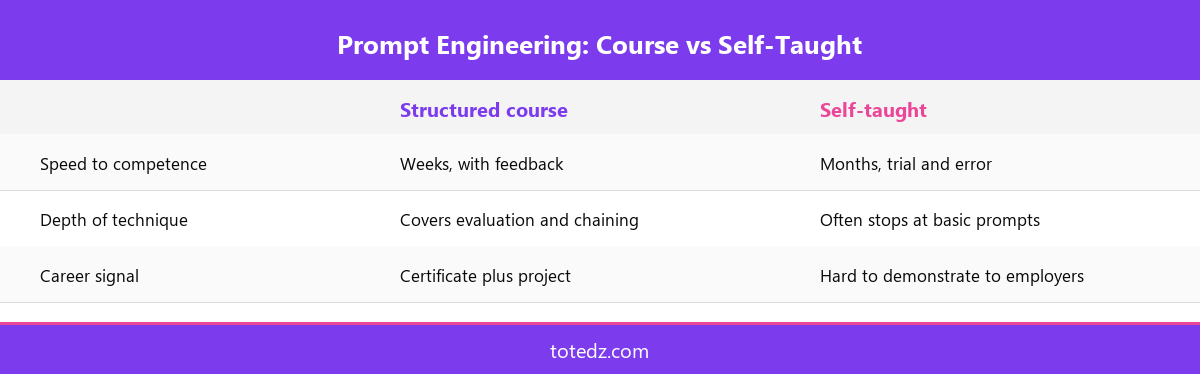
Casual users experimenting with a chatbot for personal tasks rarely need a paid course; free guides and practice cover most of what they need. A structured course earns its cost for two groups specifically: professionals who need to use AI tools reliably inside a specific workflow at work, and career switchers trying to build a demonstrable, interview-ready skill from scratch.
For the second group especially, a course with mentor feedback closes a gap that self study struggles with: knowing whether your prompting approach is actually good, or just appears to work on the handful of examples you happened to try.
There is a third group worth naming honestly: small business owners and freelancers who want to fold AI assisted work into their own service offering, drafting, research, basic automation, without hiring additional staff. For this group, the return on a course is often the fastest of all three, since even modest time savings translate directly into billable capacity rather than a resume line that may or may not get noticed.
How a Totedz Counselor Helps You Decide
Whether this specific course is worth it depends heavily on your starting role and goal, something a generic course description cannot assess. A counselor can weigh your situation directly and, where a broader foundational AI course would serve you better than a narrow prompting specialization, say so plainly rather than pointing you toward whichever program the platform happens to be promoting.
This matters because prompting skills alone, without any broader context of how generative tools fit into a business workflow, can leave a learner able to demonstrate a trick but not able to explain its business value in an interview.
A Quick Self-Check Before Enrolling
- Can you already get consistent, useful output from a free AI tool for at least one real task? If not, start there before paying for a course.
- Do you need this skill for a specific job or role change, or is it general curiosity? Course depth should match the answer.
- Would a broader generative AI course serve your goal better than a narrow prompting specialization alone?
Worth flagging too: this skill pairs unusually well with a wider generative AI course for career growth, since prompting technique alone rarely carries a career on its own. Learners who treat it as one component of a broader AI literacy, rather than the entire skill set, tend to have more durable outcomes as tools and workflows continue to change.
Conclusion
A structured course in this area is worth its fee for professionals building a specific, demonstrable skill for work, and less necessary for casual experimentation. Explore AI-related courses on Totedz or talk to a mentor to confirm whether this specific path fits your goal before enrolling.
Frequently Asked Questions
Is a prompt engineering course worth it for someone with no tech background?

How long does it take to become competent at this skill?
Should I learn this before or after a broader AI fundamentals course?
Can this skill become outdated as AI tools change?
Does Totedz offer mentor feedback specifically for this skill?