What Makes a Good Online Education Platform
 General
Most sites that teach something online look roughly the same from the outside: a search bar, rows of course thumbnails, a price tag, and a button that says enroll. What separates a genuinely good e learning platform from a glorified video library rarely shows up on the homepage. It shows up in the syllabus depth, the support available once you get stuck, and whether the certificate at the end means anything to the people reading your resume. This piece breaks down the features that actually matter, so the next comparison you run is based on substance rather than which site has the nicer landing page.
Content Quality Over Content Volume
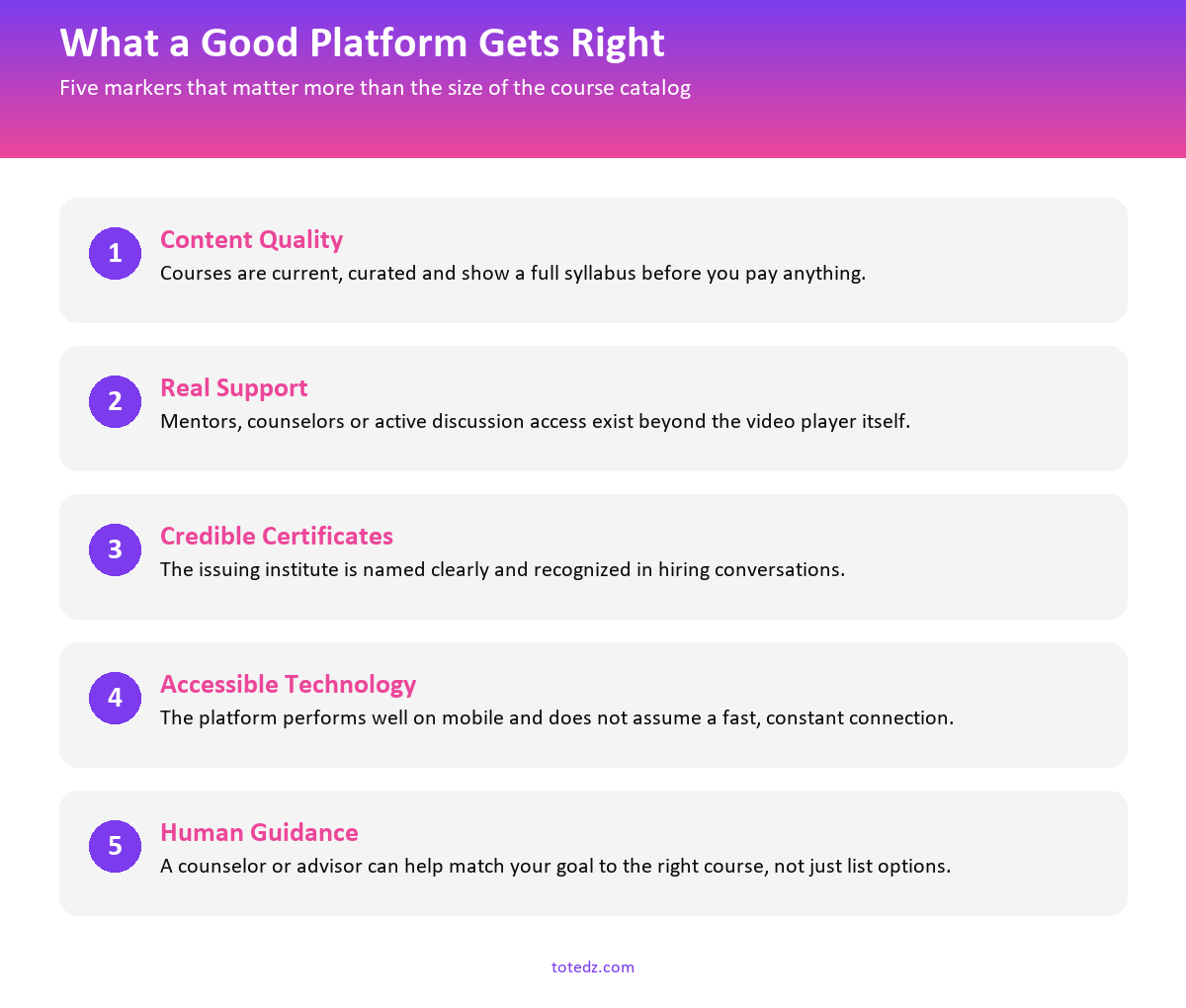
A catalog with fifty thousand courses sounds impressive until you notice that most of them were recorded once, years ago, and never updated. A strong platform curates rather than accumulates, keeps course material current with the subject it teaches, and makes the syllabus visible before enrollment rather than after payment. Organizations such as Quality Matters publish peer reviewed rubrics for exactly this reason, since course design quality varies enormously even within a single subject area, and a learner has almost no way to tell the difference just by browsing thumbnails.
Support Systems Beyond the Video Player
This is the feature most comparison lists skip entirely. A pure content library assumes every learner is self directed, confident, and able to debug their own confusion without help. In practice, most people stall out somewhere in the middle of a course, not because the material is too hard, but because nobody is available to answer one specific question at the moment it comes up. Platforms that pair content with real mentorship, discussion access, or structured check ins see meaningfully better completion rates than those that do not, which is the entire argument behind mentor supported learning as a design choice rather than an add on feature.
Credibility That Survives an Interview
A certificate only matters if a hiring manager recognizes what it represents. That means the issuing institute needs to be named clearly, the syllabus needs to map to real, describable skills, and the platform itself needs a track record beyond a single flashy marketing page. Background reading on how large scale open courses are typically run is useful here, since it explains why some certificates carry weight in hiring conversations while others, despite looking nearly identical, do not.
Technology and Accessibility Basics
None of the above matters much if the platform itself is difficult to use. A dependable online training platform works reasonably well on an average smartphone, not just a laptop, since a large share of learners in India study primarily on mobile data between other commitments. Downloadable materials for offline review, clear progress tracking, and a mobile experience that does not silently drop video quality on a weaker connection all sound like small details until one of them breaks in the middle of an exam week. Platforms rarely advertise this, so it is worth testing a free preview lesson on the device you will actually use before paying for anything.
What a Marketplace Model Adds That a Catalog Cannot
A single provider platform can only ever offer what that one provider built. A marketplace structure, where multiple academies list courses and counselors help match learners to the right one, solves a different problem: it removes the guesswork of picking blind from thousands of nearly identical looking listings. Instead of comparing course thumbnails alone, a learner can browse the full course catalog by actual outcome and still get a second opinion from a counselor before committing money or months of time. That combination, breadth of choice plus a human filter, is difficult for a single provider site to replicate no matter how good its individual courses are.
How to Actually Compare Platforms
Rather than judging by homepage design or course count, check three things directly: how recently the syllabus was updated, what support exists after enrollment, and how the platform handles refunds or switching if a course turns out to be the wrong fit. For a structured way to run that comparison across several options at once, a side by side platform comparison is a good starting reference, and if you already know the subject but not which specific course to pick within it, a step by step course finder framework narrows that down further. Learners chasing a free certificate as a first test should also look at free courses that are genuinely worth the time, and anyone weighing a fast growing field such as artificial intelligence can start with a beginner path into AI skills before comparing specific platforms at all. Our complete guide to choosing the right platform pulls all of this into one place.
The Bottom Line
A good online training platform is judged by what happens after enrollment, not before it. Current material, real support when a learner gets stuck, a certificate that means something in an interview, and a way to get human input on a genuinely confusing decision matter far more than the size of the course catalog on display. Judge platforms against those four things, and the marketing pages become much easier to see through.